
Organic search drives 53% of all B2B website traffic. Yet most product-led growth companies treat SEO as an afterthought — pouring budget into paid channels while their competitors quietly build content moats that generate signups around the clock. The irony? PLG companies are uniquely positioned to dominate organic search because their product is the conversion event.
Product-led SEO bridges the gap between search engine optimization and product-led growth strategy. Instead of optimizing for vanity metrics like keyword rankings, it aligns every piece of content with a self-serve signup path. The result: a compounding acquisition engine that gets cheaper over time while paid channels only get more expensive.
What You’ll Learn
- What product-led SEO is and how it differs from traditional SaaS SEO
- How to map content to every stage of the PLG signup funnel
- Why use-case content is the PLG secret weapon
- How to do intent-first keyword research for product-led companies
- How to build a PLG content hub that compounds
- How to measure product-led SEO impact on business metrics
- A 30-day quick-start framework to get started
What Is Product-Led SEO?
Product-led SEO is an organic search strategy designed around your product’s problem-solving capabilities rather than generic industry keywords. Where traditional SaaS SEO chases high-volume terms and funnels visitors through gated content and sales calls, product-led SEO creates content that demonstrates how your product solves specific problems — and lets visitors experience that value immediately through self-serve signup.
The fundamental difference comes down to intent alignment. Traditional SaaS SEO might target “project management best practices” and gate a PDF behind a lead form. Product-led SEO targets “how to track tasks across remote teams” and shows exactly how the product handles that workflow — with a free trial link right there.
This matters because PLG companies don’t have sales teams doing the heavy lifting. When someone from a product-led growth company lands on your site from Google, the content itself must do the selling. There’s no SDR follow-up, no demo booking. The content either moves the visitor toward trying your product or it doesn’t.
Product-Led SEO vs. Traditional SaaS SEO
| Dimension | Traditional SaaS SEO | Product-Led SEO |
|---|---|---|
| Primary goal | Generate MQLs for sales team | Drive self-serve signups |
| Content focus | Thought leadership, gated assets | Use-case content showing product value |
| Keyword strategy | High-volume industry terms | High-intent problem/solution terms |
| Conversion path | Content → form → sales call → demo | Content → free trial → activation |
| Success metric | Leads generated | Content-assisted signups and activation |
| Time to value | Weeks (sales cycle) | Minutes (self-serve) |
The Content-to-Signup Funnel for PLG Companies
The PLG content funnel looks different from a traditional marketing funnel because the product replaces the sales team. Instead of nurturing leads through email sequences toward a demo call, you’re guiding searchers from problem awareness to product activation — often in a single session.
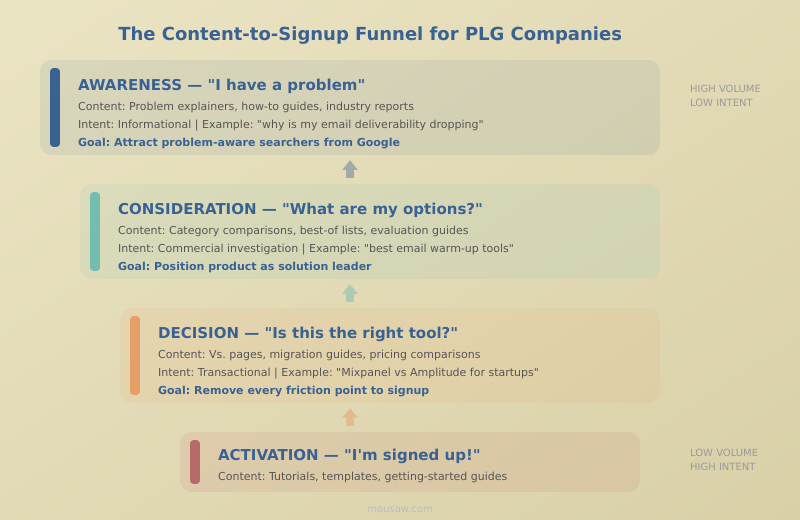
Understanding these four stages helps you build a content marketing strategy that covers every intent along the buyer journey.
Stage 1: Awareness — “I have a problem”
Searchers at this stage don’t know your product exists. They’re typing symptoms into Google: “why is my email deliverability dropping” or “how to reduce customer churn.” Your content should answer these questions thoroughly while naturally positioning your product as a solution category.
Stage 2: Consideration — “What are my options?”
Now they know solutions exist and are comparing approaches. Keywords shift to comparisons and categories: “best email warm-up tools” or “automated vs. manual A/B testing.” Create content that honestly evaluates approaches while demonstrating your product’s advantages.
Stage 3: Decision — “Is this the right tool?”
They’re evaluating your specific product against alternatives. Target “vs.” keywords, integration guides, and migration content: “Mixpanel vs. Amplitude for startups” or “how to migrate from Mailchimp.” Bottom-of-funnel content should remove every friction point between interest and signup.
Stage 4: Activation — “How do I get value fast?”
Post-signup content that drives activation. “How to set up your first Zapier workflow” or “getting started with Airtable templates.” This content also ranks in Google and brings in new users who see immediate product value in the search results.
| Stage | Content Type | Keyword Intent | Example | Goal |
|---|---|---|---|---|
| Awareness | Problem explainers, how-to guides | Informational | “Why do customers churn?” | Attract problem-aware searchers |
| Consideration | Category comparisons, best-of lists | Commercial investigation | “Best churn prediction tools” | Position product as category leader |
| Decision | Vs. pages, migration guides, case studies | Transactional | “Mixpanel vs Amplitude” | Remove signup friction |
| Activation | Tutorials, templates, getting-started guides | Navigational / how-to | “Airtable project tracker template” | Drive product activation |
Use-Case Content: The PLG Secret Weapon
Use-case content is the single most effective content type for product-led companies. It targets specific problems your product solves, attracts high-intent searchers, and naturally showcases product value — all in one piece. The best PLG companies build entire content ecosystems around use cases.
The formula is straightforward: take every feature your product offers, identify the problem it solves, and create content around the search query someone would type when experiencing that problem. Calendly doesn’t just write about “scheduling software.” They create pages for every use case: scheduling for recruiters, scheduling for sales teams, scheduling for educators, scheduling for healthcare. Each page targets a specific audience and keywords while demonstrating exactly how Calendly solves their particular problem.
Zapier built an empire on this approach. Their integrations pages — “Connect Slack with Google Sheets,” “Automate Gmail to Trello” — target thousands of long-tail keywords. Each page is both a content asset and a product demonstration. When someone searches “automatically save Gmail attachments to Dropbox,” Zapier’s page ranks, explains the workflow, and offers a one-click template to set it up. The content is the product experience.
The best product-led content doesn’t feel like marketing. It feels like documentation for a problem the reader didn’t know had a solution. When someone Googles their problem and finds your content showing exactly how your product fixes it, the signup is a natural next step — not a hard sell.
Ahrefs follows a similar playbook. Blog posts like “How to do keyword research” aren’t generic guides — they walk readers through the process using Ahrefs’ tools with real screenshots and data. Every tutorial doubles as a product demo. Readers learn the concept while simultaneously seeing why they need the tool.
Audit every feature your product offers and ask: “What problem does this solve, and what would someone Google when they have that problem?” Each answer becomes a use-case content piece. The more specific your use cases, the higher the search intent — and the more likely the visitor is to sign up.
Intent-First Keyword Research for Product-Led Companies
Traditional keyword research starts with volume. Product-led keyword research starts with intent. A keyword with 200 monthly searches that drives 10 signups is infinitely more valuable than a keyword with 10,000 searches that drives zero. Your SEO strategy needs to prioritize conversion potential over traffic potential.
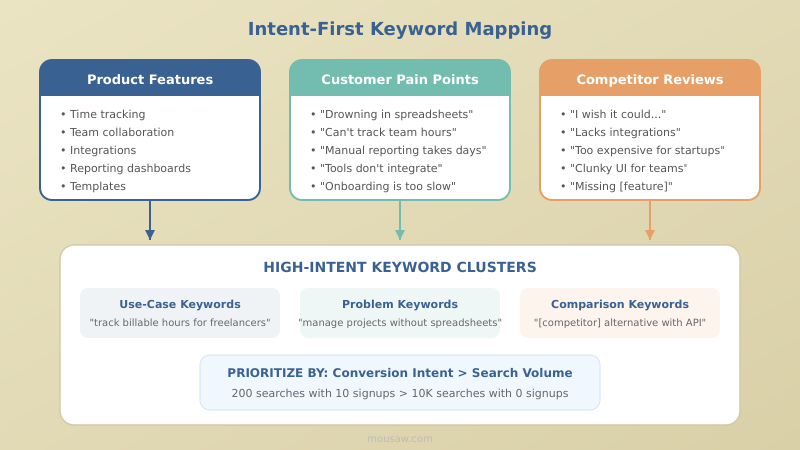
Three Sources of High-Intent Keywords
Source 1: Product features. List every feature and workflow your product enables. For each one, brainstorm the search queries someone would type when they need that capability. A project management tool with time tracking generates keywords like “track billable hours for freelancers,” “time tracking for remote teams,” and “project time estimation tool.”
Source 2: Customer pain points. Mine support tickets, onboarding calls, and review sites for the exact language customers use to describe their problems before they found your product. These phrases are goldmines because they match real search behavior. If customers say “I was drowning in spreadsheets before I found you,” there’s likely search volume around “manage projects without spreadsheets.”
Source 3: Competitor reviews. Read G2, Capterra, and TrustRadius reviews for your competitors. Pay attention to complaints: “I wish it could…” and “The one thing missing is…” These gaps become your content opportunities. If users complain that a competitor lacks integrations, create content targeting “[competitor] integrations” or “[competitor] alternative with better integrations.”
The Long-Tail Advantage
PLG companies have a structural advantage in long-tail keyword strategy. Because your product serves diverse use cases, you can create hundreds of specific pages targeting queries with low competition but high conversion intent. While enterprise SaaS companies chase “CRM software” (brutal competition, low conversion rate), PLG companies can dominate thousands of specific queries like “CRM for real estate agents with email automation” — and convert at 5-10x the rate.
Building a PLG Content Hub
Isolated content pieces can rank, but a structured content hub compounds over time. The hub model uses pillar articles as authority anchors with satellite content radiating outward — each piece strengthening the others through strategic internal linking. This mirrors how a content marketing strategy builds topical authority.
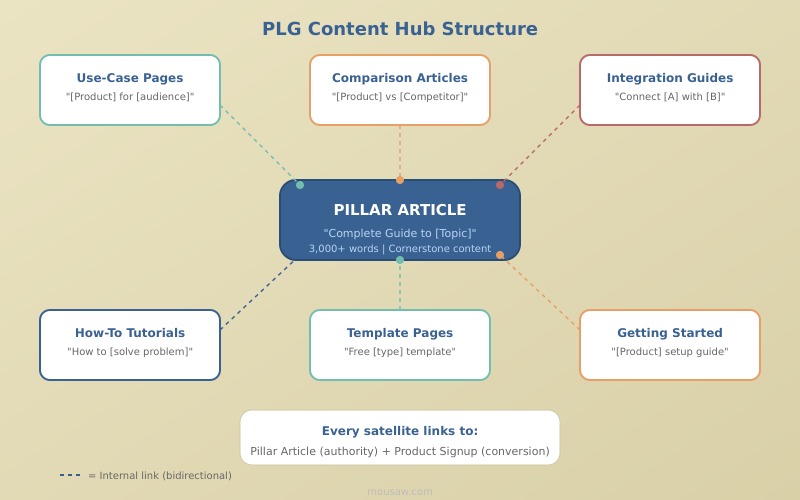
Pillar Articles: Your Authority Anchors
Each pillar covers a broad topic comprehensively: “The Complete Guide to Email Deliverability” or “Everything You Need to Know About A/B Testing.” These target competitive head terms and establish your site as an authority on the topic. They link out to every related satellite piece.
Satellite Content: The Conversion Layer
Satellites target specific long-tail queries with high conversion intent. They’re your use-case pages, comparison articles, tutorials, and integration guides. Each satellite links back to its pillar (boosting the pillar’s authority) and to the product’s signup or free trial page.
The Compounding Effect
As you publish more satellite content, two things happen. First, your pillar articles gain authority from the internal links, helping them rank for competitive terms. Second, each new satellite captures additional long-tail traffic. A hub with 1 pillar and 20 satellites might generate 50 signups per month. Add 20 more satellites and you could see 120 — the relationship isn’t linear because authority compounds.
Measuring Product-Led SEO Impact
Product-led SEO demands different metrics than traditional SEO reporting. Traffic and rankings matter, but only as leading indicators. The metrics that matter connect content to business outcomes: signups, activation, and revenue attributable to content.
Key Metrics for PLG Content
Target: 2-5%
Target: 3-8%
Target: 25-40%
Content-assisted signup rate measures the percentage of blog visitors who sign up for a free trial within the same session or within a 7-day attribution window. Track this in GA4 using custom events and segment by landing page to identify which content converts best.
Organic-to-trial conversion tracks the percentage of organic search visitors specifically (excluding direct, social, and referral traffic) who start a free trial. This isolates SEO’s contribution to your PLG funnel from other channels.
Content-sourced activation rate measures how many content-assisted signups actually reach your product’s activation milestone — the moment they experience core value. A low number here means your content is attracting the wrong audience or setting incorrect expectations about the product.
Beyond these three, monitor churn rates for content-sourced customers versus other channels. PLG companies that nail product-led SEO often find that organic-sourced users have 20-30% better retention because they arrived with a specific problem and found a specific solution.
Quick-Start Framework: Your First 30 Days
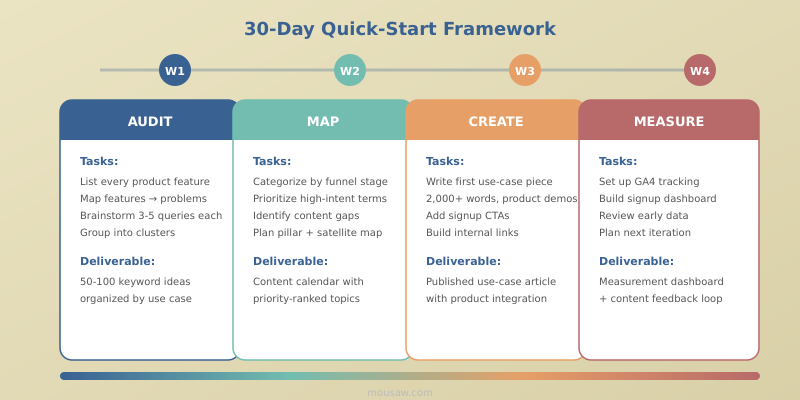
Week 1: Audit Your Product for Use-Case Keyword Opportunities
List every feature, workflow, and integration your product offers. For each item, write down 3-5 search queries someone might type when they need that capability. Group similar queries into clusters. You should end the week with 50-100 keyword ideas organized by use case.
Week 2: Map Your SaaS Funnel to Content Stages
Take your keyword clusters and categorize them by funnel stage: awareness, consideration, decision, or activation. Prioritize keywords with commercial or transactional intent — these are closer to signup. Identify gaps: most companies find they have plenty of awareness content but almost nothing for decision and activation stages.
Week 3: Create Your First Use-Case Content Piece
Pick one high-intent keyword cluster from the decision or consideration stage. Write a comprehensive piece (2,000+ words) that addresses the specific problem, walks through the solution using your product, and includes a clear signup CTA. Publish, submit to Google Search Console, and start building internal links from existing content.
Week 4: Set Up Measurement and Iterate
Configure GA4 events to track content-to-signup paths. Set up a simple dashboard showing: organic traffic to the new piece, signup clicks, and actual conversions. Review performance after 2-4 weeks of data and use insights to refine your next piece. The goal isn’t perfection — it’s establishing the feedback loop between content, product, and measurement that makes PLG SEO compound.
Frequently Asked Questions
Conclusion
Product-led SEO isn’t a new buzzword — it’s the natural evolution of organic search strategy for companies where the product sells itself. By aligning your content with specific product use cases, targeting intent over volume, and measuring content’s impact on signups and activation rather than just traffic, you build an acquisition engine that compounds month over month.
The companies that dominate product-led SEO — Zapier, Ahrefs, Calendly, Notion — didn’t get there by chasing generic keywords or gating every asset behind a form. They created content that demonstrated product value at every stage of the buyer journey and made it effortless to go from reading an article to experiencing the product.
Start with your product features. Identify the problems they solve. Find the search queries people type when they have those problems. Then create content that bridges the gap between the problem and your product. That’s product-led SEO in a nutshell — and it’s the most efficient way to grow a self-serve SaaS company through organic search.