
What Is Topical Authority?
Topical authority is your website’s demonstrated expertise on a specific subject — measured not by a single page, but by how comprehensively your content covers every angle of a topic. When Google sees a tightly connected set of pages all reinforcing the same theme, it trusts your site more than a competitor with one great article and nothing around it.
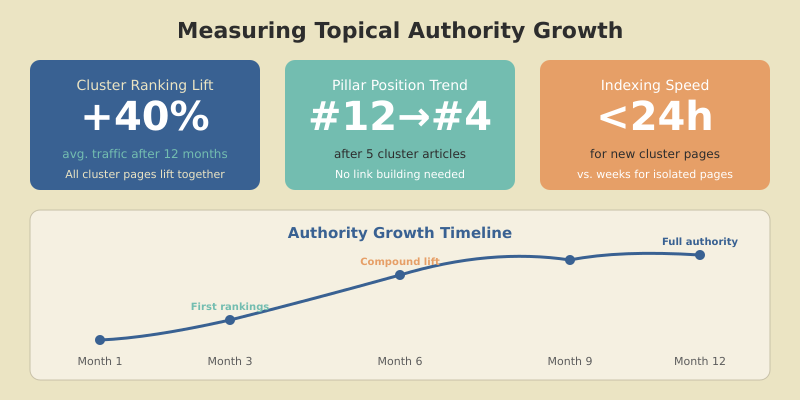
I’ve watched this play out dozens of times. A SaaS blog I worked with had a solid pillar article on “SaaS growth strategy” sitting at position 12 for months. After we published five supporting cluster articles — each targeting a subtopic like churn benchmarks, pricing models, and onboarding — the pillar climbed to position 4 within eight weeks. No link building. No technical changes. Just topical depth.
In this guide, I’ll show you exactly how to build topical authority using content clusters — the hub-and-spoke model that turns scattered blog posts into a structured SEO machine. You’ll learn how to choose your topics, structure your pillar and cluster pages, build internal links that actually move rankings, and measure whether your authority is growing.
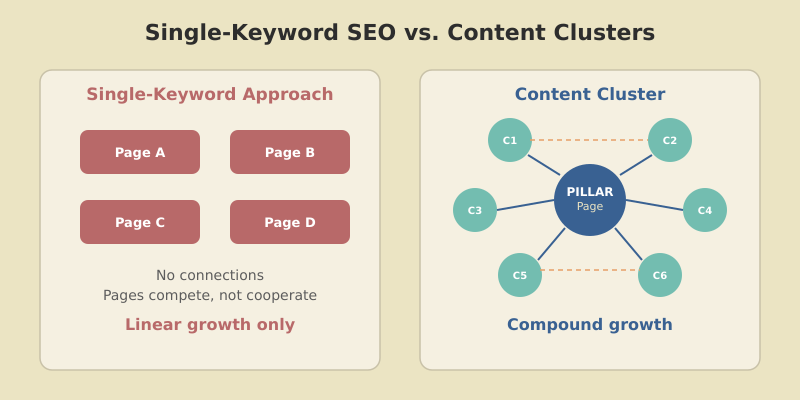
Why Topical Authority Beats Single-Keyword SEO
The old approach was simple: find a keyword, write a page, build some links, rank. That worked when Google’s algorithm was essentially pattern-matching keywords to queries. It doesn’t work anymore.
Google’s language models now understand topics, not just terms. As Google’s helpful content guidelines emphasize, the search engine rewards sites that demonstrate depth and first-hand expertise on a subject. When someone searches “how to reduce SaaS churn,” Google doesn’t just find pages with those exact words — it evaluates whether your site has demonstrated knowledge across the broader topic of SaaS retention, customer success, and growth metrics.
Here’s what topical authority gives you that single-keyword targeting can’t:
Compound ranking gains
When you publish cluster article #5, it doesn’t just rank itself — it lifts the pillar and all sibling clusters. Sites that sustain cluster publishing for 12+ months see 40% higher organic traffic than comparable single-page strategies.
Featured snippet and AI Overview dominance
Google’s AI Overviews pull from sites it trusts on a topic. That trust comes from breadth, not just depth on a single page. A content cluster gives you multiple entry points into AI-generated answers.
Faster indexing of new content
When you add a new cluster page to an established topic hub, Google crawls and indexes it faster because it already trusts your site on that subject. I’ve seen new cluster pages indexed within hours, not weeks.
The Content Cluster Model Explained
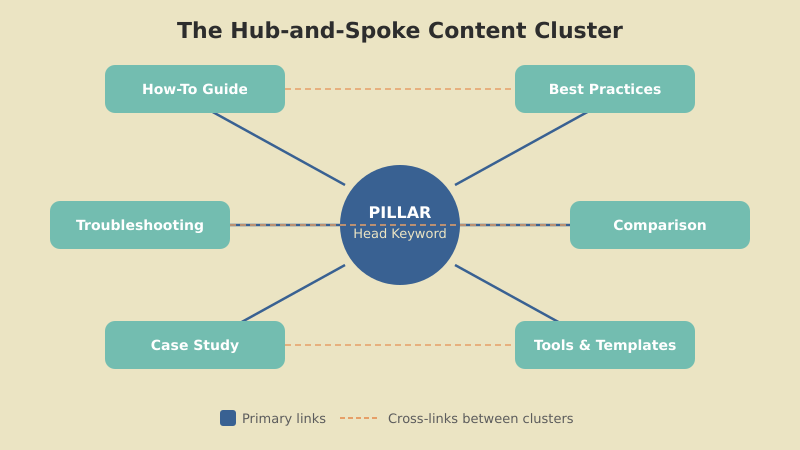
A content cluster has three components: a pillar page, cluster pages (also called satellites), and the internal links connecting them. Think of it as a hub-and-spoke wheel — the pillar is the hub, clusters are the spokes, and links are what holds the wheel together.
Pillar Page
The pillar is your comprehensive overview of a broad topic. It covers the full subject at a high level (typically 3,000–5,000 words), targets the primary head keyword, and links out to every cluster page for deeper dives on specific subtopics.
A good pillar page answers the question “What do I need to know about [topic]?” without going so deep on any subtopic that it steals thunder from cluster pages. Think of it as teaching someone intelligent but unfamiliar with the subject — cover enough to be useful, then point them to specialized resources.
Cluster Pages
Each cluster page focuses on one narrow subtopic (1,000–2,500 words) and targets a long-tail keyword. Cluster pages go deep where the pillar stays broad. They answer specific questions, solve particular problems, or compare specific tools.
Internal Links
Every cluster page links back to the pillar using anchor text that includes the pillar’s target keyword. The pillar links out to each cluster with descriptive anchor text. When relevant, cluster pages also link to each other — this creates a web of topical signals that search engines can follow. Search Engine Land’s topic clusters guide calls this the single most effective way to signal topical relevance to modern search algorithms.
Step 1 — Choose Your Topic and Validate Demand
Start with a topic broad enough to support 6–10 subtopics, but narrow enough that you can realistically cover it comprehensively. “Marketing” is too broad. “GA4 event tracking for SaaS websites” is too narrow for a pillar. “Google Analytics 4 for marketers” is the sweet spot.
Here’s my validation process:
- Search volume check — your head keyword should have at least 500 monthly searches. If it’s lower, the cluster won’t generate enough traffic to justify the effort.
- Subtopic count — list every subtopic you can think of. If you can’t get to at least 6 distinct subtopics with their own search demand, the topic is too narrow.
- Competitor gap analysis — search your head keyword and analyze the top 5 results. Are they individual articles or full topic hubs? If competitors already have established clusters, you’ll need stronger depth or a differentiated angle. If they don’t, you’ve found an opportunity.
- Expertise fit — can you write (or commission) authoritative content on every subtopic? Half-built clusters with thin content on some subtopics will hurt more than help.
Pro tip: Google’s “People Also Ask” boxes are a goldmine for finding cluster topics. Search your head keyword, expand every PAA question, and note the subtopics Google associates with your main topic. These are literally the questions Google’s algorithm connects to your subject.
Step 2 — Map Your Cluster Architecture
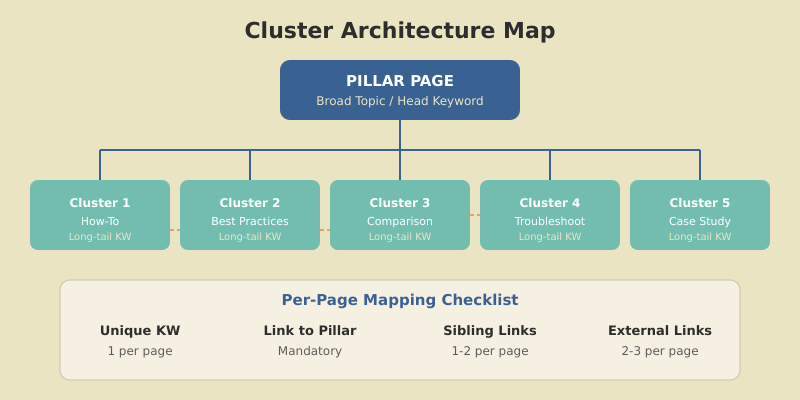
Once you’ve validated your topic, map the full cluster before writing a single word. I use a simple table format that tracks the hierarchy, target keywords, and linking relationships:
| Page | Type | Target Keyword | Links To |
|---|---|---|---|
| SEO Strategy Guide | Pillar | seo strategy | All clusters |
| Topical Authority | Cluster | topical authority SEO | Pillar, E-E-A-T cluster |
| Technical SEO Audit | Cluster | technical SEO audit | Pillar |
| AI Overviews Optimization | Cluster | AI Overviews optimization | Pillar, GEO vs SEO |
| Link Building | Cluster | link building strategies | Pillar |
This map serves three purposes: it prevents keyword cannibalization (each page has one unique target), it pre-defines your internal linking structure, and it shows you exactly how many articles you need to write.
Step 3 — Write the Pillar Page First
Always start with the pillar. It sets the scope, establishes the narrative framework, and gives cluster pages something to link back to from day one.
Your pillar page should follow this structure:
- Define the topic — what it is, why it matters, who it’s for
- Cover each subtopic at a summary level — 200–400 words per subtopic, enough to be useful but not exhaustive
- Link to cluster pages — even if they don’t exist yet. Use placeholder URLs and update them as you publish each cluster. In practice, I write all the anchor text upfront and add the hrefs later.
- Include a clear information hierarchy — H2s for major subtopics, H3s for supporting points. This structure helps Google understand your topic map.
The biggest mistake I see with pillar pages: going too deep on subtopics. If your pillar exhaustively covers “GA4 attribution models” in 2,000 words, your cluster page on that topic has nothing new to say. Keep the pillar broad — let clusters go deep.
Step 4 — Build Cluster Pages Strategically
Don’t publish cluster pages randomly. Sequence them for maximum impact:
Start with high-intent, low-competition clusters
These rank fastest and start sending traffic to your pillar immediately. “How to fix GA4 not set” will rank faster than “GA4 complete guide.”
Add cross-linking clusters next
Pages that naturally connect to multiple other clusters (and even other topic hubs) create the richest link structure. Bridge articles that span two categories are especially powerful.
Fill gaps last
Completeness matters for topical authority. Even lower-volume subtopics strengthen the cluster signal. A cluster with 8 pages covering 95% of the topic outranks one with 4 pages covering 50%.
Each cluster page should follow this linking pattern:
- One link to the pillar — in the intro or first major section, using anchor text with the pillar’s keyword
- One or two links to sibling clusters — where contextually relevant, not forced
- Two or three external links — to authoritative sources (Google documentation, industry research)
Step 5 — Internal Linking Best Practices
Internal linking is where most content clusters fail. People build the pages but phone in the links. Here’s how to do it right:
Anchor Text Rules
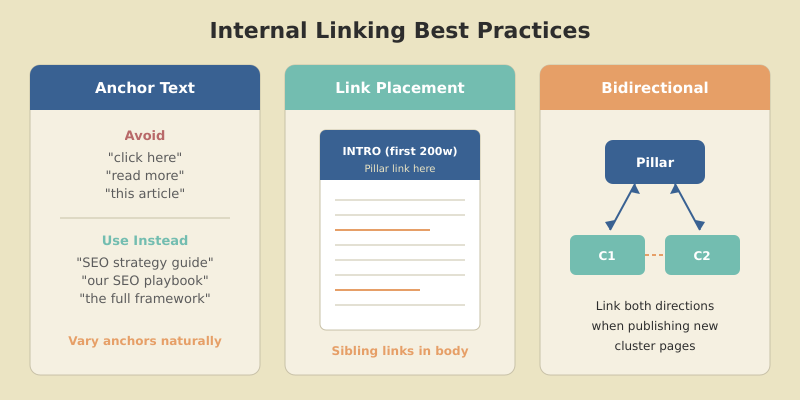
Use descriptive anchor text that tells both users and search engines what they’ll find on the other end. “Click here” and “read more” are wasted opportunities. “Our complete SEO strategy guide” is much better.
But don’t over-optimize either. If every link to your pillar uses the exact same anchor text “SEO strategy guide,” it looks manipulative. Vary it naturally: “SEO strategy framework,” “our SEO playbook,” “the full strategy guide.”
Link Placement
According to Google’s link best practices documentation, links in the first 200 words of an article carry more weight than links buried at the bottom. Place your most important internal link (usually to the pillar) early. Use contextual placement — the link should feel like a natural extension of the sentence, not a forced insertion.
Bidirectional Linking
When you publish a new cluster page, do two things: add links from the new page to the pillar and existing clusters, and go back to the pillar and add a link to the new page. This bidirectional link structure distributes PageRank evenly across the cluster and reinforces the topical relationship in both directions.
Step 6 — Measure Your Topical Authority Growth
Topical authority isn’t a metric you can check in Google Analytics. But you can track proxy signals that indicate whether your cluster strategy is working:
| Signal | How to Measure | What It Tells You |
|---|---|---|
| Cluster-wide ranking lift | Track average position for all cluster keywords in GSC | When multiple pages improve together, Google is connecting them topically |
| Pillar page position | Track pillar’s rank for head keyword over time | Pillar should climb as you add cluster pages |
| Indexing speed | Check Coverage report in GSC after publishing new clusters | Faster indexing = Google trusts your site on this topic |
| Branded topic searches | Look for “[your brand] + [topic]” queries in GSC | Users associating your brand with the topic |
| AI Overview citations | Search your cluster keywords and check if Google cites your pages in AIO | Google trusts your site enough to cite in AI-generated answers |
The most telling signal is the cluster-wide lift. If you publish a new article about “GA4 attribution models” and your existing articles on “GA4 event tracking” and “GA4 funnels” also improve in rankings, your topical authority is growing. That compound effect is the whole point.
Common Mistakes That Kill Topical Authority
I’ve audited dozens of content clusters that weren’t performing. These are the mistakes I see most often:
Keyword cannibalization
Two cluster pages targeting the same keyword will compete with each other instead of reinforcing the cluster. Every page needs a unique primary keyword. Before writing, search your own site for the keyword — if something already ranks for it, update that page instead of creating a new one.
Thin cluster pages
Publishing a 400-word article just to “fill” a cluster slot does more harm than good. Every cluster page should be the best resource available on its subtopic. If you can’t write 1,000+ useful words on a subtopic, merge it with a related cluster or cut it.
Missing internal links
You published the cluster pages but forgot to update the pillar with links to them. Or the cluster pages don’t link back to the pillar. Without bidirectional linking, Google can’t see the topical relationship. Run a quarterly audit of your clusters to catch orphaned pages.
Too many topics, too little depth
Starting five clusters simultaneously but only publishing 2–3 articles in each is worse than completing one cluster fully. A half-built cluster sends a weak topical signal. Finish one cluster before starting the next.
FAQ
How many cluster pages do you need for topical authority?
Most successful clusters have 6–10 supporting pages around one pillar. Fewer than 5 won’t build enough depth to signal authority. More than 12 often indicates the topic is too broad and should be split into two clusters. Focus on quality and completeness rather than hitting a specific number.
How long does it take for topical authority to improve rankings?
Expect 3–6 months to see meaningful ranking improvements from a content cluster strategy. Individual cluster pages may rank for long-tail keywords within weeks, but the compound “topical authority lift” on your pillar page typically takes 4–6 months as Google re-evaluates your site’s expertise.
Can you build topical authority with AI-generated content?
AI can help draft content faster, but topical authority requires genuine expertise — original insights, real data, and practical experience that AI alone can’t provide. Use AI to accelerate production, then layer in E-E-A-T signals: personal anecdotes, proprietary data, and expert opinions.
Should I update old articles or write new cluster pages first?
If you already have articles on related subtopics, update them first — add internal links, improve depth, and integrate them into the cluster. It’s faster than writing from scratch and leverages any existing authority those pages have built. Only write new pages for subtopics you haven’t covered.
Does topical authority help with Google AI Overviews?
Yes. Google’s AI Overviews cite sources it trusts on a topic, and topical authority is a key trust signal. Sites with comprehensive content clusters are more likely to be cited in AI-generated answers because Google has more evidence of their expertise across the full topic.
Start Building Your First Content Cluster
Topical authority isn’t a tactic you bolt on — it’s a publishing strategy that compounds over time. The sites winning in 2026’s search landscape aren’t the ones with the most content. They’re the ones with the most connected content.
Here’s what to do this week: pick one topic your site should own. Map 6–8 subtopics around it. Write the pillar page. Then publish one cluster article per week until the hub is complete. Within 3–6 months, you’ll see the compound ranking effect that makes content clusters the most reliable SEO strategy available.
If you’re working in SEO, start with our SEO strategy playbook — it covers the full framework including technical SEO, link building, and E-E-A-T alongside topical authority. Already have content that needs organizing into clusters? A content marketing strategy will help you audit what you have and map it to clusters.