
Here’s a number that should make every SEO rethink their strategy: the same brand can have a 27% citation rate on one AI platform and a 0.59% rate on another. That’s a 46x gap — for identical content. If you’re still thinking about generative engine optimization as a single discipline, you’re already falling behind.
AI-powered search is no longer a future trend. ChatGPT processes hundreds of millions of queries daily. Google AI Overviews appear on a growing share of search results. Perplexity is the fastest-growing search product since Google itself. Together, these platforms are reshaping how people find, evaluate, and choose brands — and the rules are fundamentally different from traditional SEO strategy.
I started auditing AI citations for clients in early 2025. The first thing I discovered was that none of the standard GEO advice actually matched what was happening across platforms. ChatGPT, Perplexity, and Google AI Overviews each have their own citation logic, favor different source types, and respond to different optimization signals. Treating them as one channel is like running the same ad on TV, radio, and TikTok — technically possible, strategically useless.
This guide breaks down exactly how GEO differs from SEO, how each AI platform selects sources, and what you can do today to earn citations where your audience is actually searching.
What You’ll Learn
- What generative engine optimization is and why it matters now
- The key differences between GEO and SEO
- How ChatGPT, Perplexity, and Google AI Overviews cite differently
- The 9 research-backed tactics that improve AI citations
- The unowned content strategy most brands ignore
- How to measure GEO when most AI traffic is invisible
- A practical GEO framework for B2B SaaS companies
What Is Generative Engine Optimization (GEO)?
Generative engine optimization is the practice of optimizing your content to be cited, referenced, or recommended by AI-powered search engines. While traditional SEO focuses on ranking in a list of ten blue links, GEO focuses on getting your brand mentioned inside the AI-generated answer itself.
The concept was formalized in a 2024 paper by researchers at Princeton and Georgia Tech, published at the KDD conference. They tested nine specific optimization tactics and measured which ones actually increased a website’s visibility in AI-generated responses. The findings were clear: adding statistics, citing authoritative sources, and including expert quotations produced the largest gains — up to 40% improvement in AI citation frequency.
What makes GEO fundamentally different from SEO is the output format. In traditional search, Google shows you a ranked list and you click a link. In generative search, the AI synthesizes information from multiple sources into a single answer — and may or may not link back to those sources. Your content doesn’t “rank” in a position. It either gets cited or it doesn’t.
GEO vs. SEO: The Key Differences
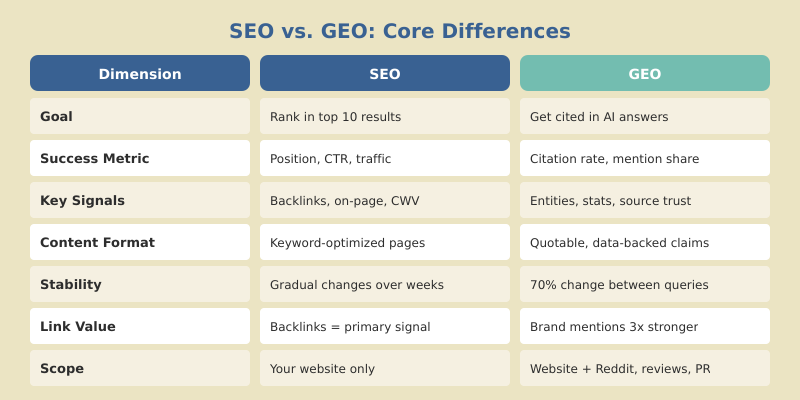
SEO and GEO share the same foundation — creating high-quality, authoritative content. But they diverge sharply in how that content gets surfaced to users. Understanding these differences is critical for allocating your optimization effort.
| Dimension | Traditional SEO | GEO |
|---|---|---|
| Goal | Rank in top 10 organic results | Get cited in AI-generated answers |
| Success metric | Position, CTR, organic traffic | Citation frequency, brand mention share |
| Ranking signals | Backlinks, on-page optimization, Core Web Vitals | Entity clarity, statistical evidence, source authority |
| Content format | Keyword-optimized pages and blog posts | Structured, quotable statements with data |
| User experience | User clicks link, lands on your page | User reads AI answer — may never visit your site |
| Stability | Rankings change gradually over weeks | Citations change ~70% between identical queries |
| Link value | Backlinks are a primary ranking factor | Brand mentions correlate 3x more with AI visibility |
| Scope | Your website only | Your website + third-party mentions (Reddit, reviews, forums) |
The most significant shift is in the last row. In SEO, you optimize your own website and build backlinks to it. In GEO, your “optimization surface” extends far beyond your domain. What people say about your brand on Reddit, G2, Quora, and in industry publications directly influences whether AI platforms cite you.
That said, GEO doesn’t replace SEO — it builds on it. Google AI Overviews, for example, pull 76-93% of their citations from pages that already rank in the organic top 10. Strong SEO is still the foundation. GEO adds a new layer on top.
Three Different Games: How Each AI Platform Cites Content
This is where most GEO advice falls apart. Every article tells you to “optimize for AI search” as if it’s one thing. The data tells a completely different story. ChatGPT, Perplexity, and Google AI Overviews operate on fundamentally different citation logic.
I ran a citation audit across all three platforms for a B2B SaaS client in late 2025. The same brand was cited in 8 out of 10 Perplexity answers, 3 out of 10 Google AI Overviews, and zero ChatGPT responses. Same brand, same content, same queries — wildly different results. That experience convinced me that platform-specific GEO strategy isn’t optional — it’s the entire game.
Google AI Overviews
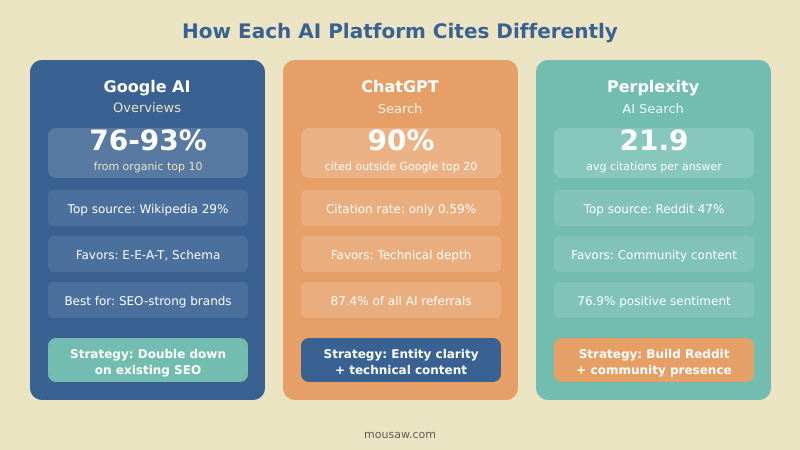
Google’s AI Overviews are the most SEO-friendly of the three. Between 76% and 93% of cited sources already rank in Google’s organic top 10. This means your existing SEO investment directly fuels your Google AI visibility.
Google AI Overviews favor Wikipedia (28.9% of top citations), established news sites, and authoritative .edu/.gov domains. The system rewards pages with clear factual statements, structured data markup, and E-E-A-T signals. If you’ve followed the AI Overviews optimization playbook, you’re already well-positioned here.
ChatGPT
ChatGPT plays by entirely different rules. A staggering 90% of pages ChatGPT cites rank outside Google’s top 20 in organic search. This means ChatGPT draws from a completely different authority pool than Google — and a strong Google ranking gives you almost no advantage in ChatGPT citations.
ChatGPT’s citation rate is the lowest of the three platforms — just 0.59% on average. But it drives 87.4% of all AI referral traffic by sheer volume. The platform favors comprehensive, technically detailed content with clear entity definitions. It rarely cites content with marketing language or promotional framing — only 6.8% of ChatGPT citations carry positive sentiment.
Perplexity
Perplexity is the most citation-generous platform, averaging 21.87 citations per answer compared to ChatGPT’s 7.92. It’s also the most diverse in source selection, with Reddit accounting for 46.7% of top citations.
This creates a unique optimization vector: building genuine presence in community discussions, Q&A threads, and forum conversations directly improves your Perplexity visibility. Perplexity also shows the highest positive sentiment in citations (76.9%), suggesting it favors helpful, solution-oriented content over neutral encyclopedic entries.
For Google AI Overviews, double down on your existing SEO. For ChatGPT, focus on technical depth and entity clarity — forget about your Google ranking. For Perplexity, build authentic community presence on Reddit and forums. Optimizing for all three requires three distinct approaches, not one generic GEO strategy.
The 9-Tactic GEO Checklist (Backed by Research)
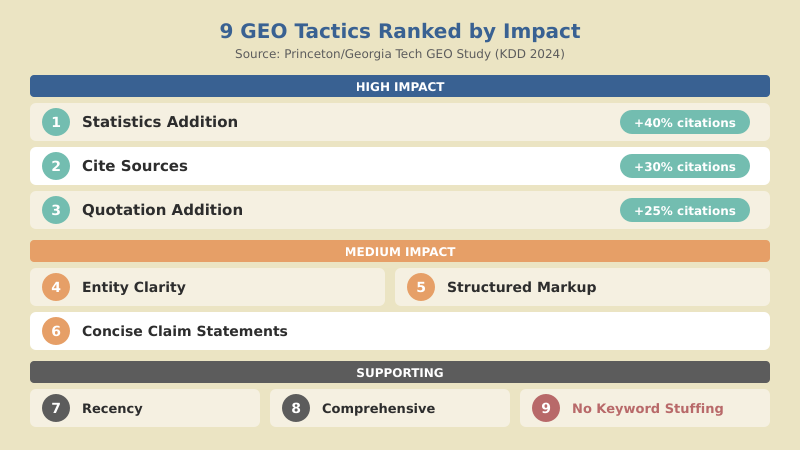
The Princeton/Georgia Tech study tested nine specific optimization tactics and measured their impact on AI citation rates. Not all tactics are created equal — and one popular SEO practice actually hurts your GEO performance.
High-Impact Tactics
1. Statistics Addition — The single most effective tactic. Adding specific, sourced statistics to your content increased AI citations by up to 40%. AI engines treat quantified claims as higher-authority evidence. Instead of writing “most companies struggle with retention,” write “the median SaaS company experiences 5.2% monthly logo churn, according to ChartMogul’s 2025 benchmark report.”
2. Cite Sources — Explicitly referencing authoritative sources within your content (industry reports, academic papers, official documentation) signals credibility. AI models are trained to favor well-sourced information. Name the source, include the year, and link to it.
3. Quotation Addition — Including direct quotes from recognized experts or official sources gives AI engines concrete, attributable statements to cite. Expert quotes serve double duty: they strengthen E-E-A-T for traditional SEO and improve citation probability for GEO.
Medium-Impact Tactics
4. Entity Clarity — Define key terms clearly and unambiguously. AI models rely on entity recognition to understand what your content is about. Use the full name of a concept on first reference, provide a clear definition, and maintain consistent terminology throughout.
5. Structured Markup — Schema.org markup (FAQ, HowTo, Article) helps AI engines parse your content structure. The emerging llms.txt protocol — a GEO-specific robots.txt that directs AI crawlers to your best content — is being adopted by over 600 sites.
6. Concise Claim Statements — Write clear, standalone sentences that answer specific questions. AI engines often extract single sentences or short paragraphs as citations. If your key claims are buried in lengthy paragraphs, they’re harder to cite.
Supporting Tactics
7. Recency Signals — AI engines prefer sources that are 26% fresher than those favored by traditional search. Content older than 3 months sees a sharp drop in citation frequency. Update dates, refresh statistics, and add current examples regularly.
8. Comprehensive Coverage — Pages that cover a topic end-to-end from multiple angles are cited more frequently than narrowly focused content. This aligns with the topical authority principle in traditional SEO.
9. Avoid Keyword Stuffing — This is the critical finding: keyword stuffing, which already hurts SEO, actively damages GEO performance. The Princeton study showed it was the only tactic that consistently decreased citation rates. Write naturally.
The brands that win in AI search are not the ones producing the most content — they’re the ones producing the most citable content. Every claim backed by a statistic, every definition written with entity clarity, every expert quote with proper attribution — these are the building blocks of GEO visibility.
The Unowned Content Strategy Most Brands Ignore
Here’s the GEO insight that changes everything: brand mentions across the web correlate 3x more strongly with AI visibility than traditional backlinks. This means what other people say about your brand matters more than what you say about yourself — at least in the eyes of AI engines.
In traditional SEO, you control your optimization surface. You write content, build backlinks to it, and optimize on-page elements. In GEO, your “optimization surface” extends to every place your brand is mentioned online: Reddit threads, G2 reviews, Quora answers, industry reports, news articles, and podcast transcripts.
Consider this: Reddit accounts for 46.7% of Perplexity’s top citations. If your brand is actively discussed in relevant Reddit communities — genuine discussions, not spam — Perplexity is more likely to cite you when users ask questions in your category. The same applies to Wikipedia (28.9% of Google AI Mode citations) and review platforms like G2 and Capterra.
This doesn’t mean gaming these platforms. AI engines are specifically designed to detect and penalize promotional content. It means investing in genuine community presence: contributing helpful answers in subreddits, encouraging authentic customer reviews, pursuing press coverage that mentions your brand in editorial context, and ensuring your product information on third-party comparison sites is accurate and up-to-date.
One actionable starting point: audit your brand mentions across the top AI citation sources. Search for your brand name on Reddit, G2, Capterra, Wikipedia, and major industry publications. Where are you mentioned? Where are you absent? Where are you misrepresented? That gap analysis becomes your unowned content strategy roadmap.
Measuring GEO: The Attribution Problem
Here’s the dirty secret of GEO measurement: most AI-driven traffic is invisible in your analytics. ChatGPT’s free tier, Claude, and most AI assistants don’t pass referrer data or UTM parameters. Those visits show up as “Direct” traffic in GA4 — mixed in with bookmarks, typed URLs, and dark social.
This creates a dangerous blind spot. A brand might be getting hundreds of AI-referred visits per month and have no idea because GA4 attributes them all to Direct. I’ve seen clients dismiss AI search as irrelevant based on analytics data that was fundamentally undercounting AI traffic by 3-5x.
To get closer to reality, you need a multi-layered measurement approach.
~15-20% of actual
~60-70% of actual
Unmeasurable in GA4
Three Measurement Layers
Layer 1: GA4 Channel Attribution. Set up custom channel groups in GA4 to capture identifiable AI referral traffic. Create regex-based rules for known AI referrers: chatgpt.com, perplexity.ai, gemini.google.com, and AI-specific UTM parameters. This captures the 15-20% of AI traffic that does pass referrer data.
Layer 2: Direct Traffic Anomaly Analysis. Monitor your Direct traffic channel for unexplained spikes that correlate with AI citation events. If your brand gets mentioned in a viral ChatGPT answer pattern and Direct traffic jumps 30% without any other explanation, that delta is likely AI-driven. Track Direct traffic trends weekly and cross-reference with citation monitoring.
Layer 3: Manual Citation Auditing. Run your 15-20 most important search queries through ChatGPT, Perplexity, and Google AI Mode monthly. Document which queries cite your brand, which cite competitors, and how the answers change over time. This qualitative data is currently more reliable than any automated tool for understanding your actual AI visibility.
GEO for B2B SaaS: A Practical Framework
B2B SaaS companies face a unique GEO landscape. Forrester reports that 89% of B2B buyers now use AI tools during their purchase research process. Gartner predicts the majority of B2B buyers will use AI to shortlist vendors by the end of 2026. If your SaaS product isn’t being cited when buyers ask AI engines for recommendations, you’re not on the shortlist.
The good news: SaaS products generate naturally citable content. Every feature solves a specific problem. Every use case maps to a search query. Every integration connects to an existing workflow. This is the same principle behind product-led SEO — your product is your content advantage.
The 30-Day GEO Quick-Start for SaaS
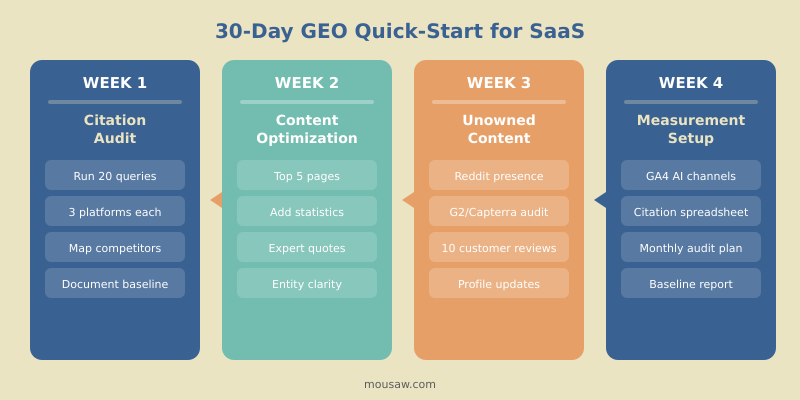
Week 1: Citation Audit. Run your top 20 product-related queries through ChatGPT, Perplexity, and Google AI Mode. Document where you’re cited, where competitors appear, and where nobody shows up. This baseline reveals your biggest opportunities.
Week 2: Content Optimization. Take your 5 highest-traffic pages and apply the top three GEO tactics: add sourced statistics, include expert quotes, and improve entity clarity. Don’t rewrite from scratch — augment what already ranks well with citable elements.
Week 3: Unowned Content Blitz. Audit your brand presence on Reddit, G2, Capterra, and industry comparison sites. Respond to existing threads about your category (not your brand — your category). Encourage 10 customers to leave detailed reviews. Update your G2 and Capterra profiles with current pricing and feature data.
Week 4: Measurement Setup. Configure GA4 custom channel groups for AI referrers. Set up a monthly citation tracking spreadsheet. Run your first manual citation audit and document the baseline. This becomes your GEO reporting foundation.
Budget Allocation
For SaaS companies starting with GEO, the industry consensus is a 20-30% allocation of your search budget toward GEO-specific activities, with the remaining 70-80% continuing to fund traditional SEO. As AI search traffic grows and your measurement matures, this ratio will shift. But don’t wait for 50/50 — the early movers in GEO are building citation authority that compounds over time, just like early SEO authority did.
Frequently Asked Questions
Moving Forward
Generative engine optimization isn’t a separate discipline from SEO — it’s the next layer. The fundamentals haven’t changed: create authoritative, well-sourced content that genuinely helps your audience. What has changed is where and how that content gets surfaced.
The brands that win in this new landscape will be the ones that understand a critical distinction: GEO is not one game. It’s three different games played on three different platforms, each with its own rules, its own citation logic, and its own optimization playbook.
Start with the 30-day framework. Audit your current AI visibility. Optimize your highest-traffic pages with the research-backed tactics. Build your unowned content presence. Set up measurement. And accept that in a world where AI answers change 70% of the time for the same query, consistency and persistence matter more than any single optimization trick.
The competitive window is open right now. AI-referred visitors convert at 4.4x the rate of organic search, but AI traffic is still less than 2% of total web traffic. The gap between early adopters and everyone else is growing every month. The question isn’t whether to invest in GEO — it’s how fast you can start.