Why Content Attribution Matters for SaaS
Most SaaS content teams can tell you which blog posts get the most pageviews. Almost none can tell you which posts actually drive signups — and even fewer can trace content to paying customers. That’s the content attribution gap, and it’s the reason 79% of marketers can’t connect content consumption to revenue outcomes.
I’ve worked with SaaS companies that were producing 8 articles per month, celebrating traffic growth, and wondering why pipeline wasn’t growing proportionally. The problem wasn’t the content — it was that nobody knew which content was working. They were optimizing for pageviews when they should have been optimizing for signups and revenue.
SaaS content attribution solves this by tracking the path from blog post to trial signup to paid conversion. When you can see that your article on “SaaS churn benchmarks” generates 3x more trial signups per pageview than your article on “SaaS trends,” you make fundamentally different content decisions. This guide shows you exactly how to build that attribution system using GA4, UTM parameters, and content marketing ROI measurement.
The Three Levels of Content Attribution
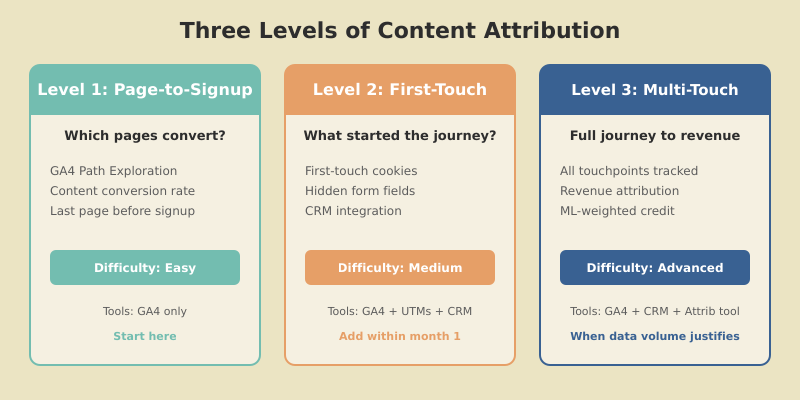
Content attribution isn’t binary — there are levels of sophistication, and you should start simple and build up:
| Level | What It Tracks | Tools Needed | Difficulty |
|---|---|---|---|
| 1. Page-to-signup | Which pages were viewed before signup | GA4 path exploration | Easy |
| 2. First-touch attribution | Which content first brought the user to your site | GA4 + UTMs + CRM | Medium |
| 3. Multi-touch to revenue | All content touchpoints from first visit to paid conversion | GA4 + CRM + attribution tool | Advanced |
Most SaaS companies should start at Level 1 and progress to Level 2 within the first month. Level 3 requires dedicated tooling and is worth it only when you’re producing enough content and generating enough conversions for the data to be meaningful.
Level 1: Page-to-Signup Tracking in GA4
This is the foundation. You want to answer one question: which pages do users view immediately before signing up?
Set Up Path Exploration
In GA4, go to Explore → Path Exploration. Configure it as follows:
- Set the ending point to your signup event (
sign_up— see our GA4 event tracking guide for setup) - Click backward from the conversion to see which pages users visited before signing up
- Filter by Page title to see content names rather than URLs
This instantly reveals your highest-converting content. When I ran this analysis for a B2B SaaS client, we discovered that their “how-to” guides drove 4x more signups per session than their thought leadership pieces — despite the thought leadership getting more social shares.
Build a Content Conversion Report
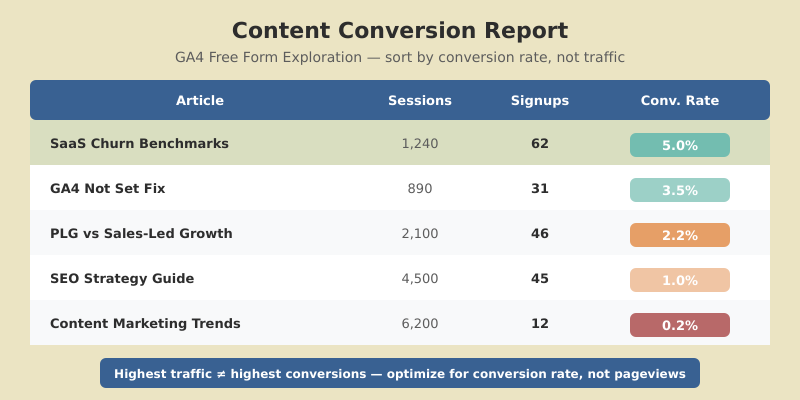
In GA4, create a Free Form Exploration with:
- Rows: Page title (or Landing page)
- Columns: (empty)
- Values: Sessions, Key events (sign_up), Key event rate
- Filter: Page path contains
/blog/(or your content path)
Sort by key event rate to find your highest-converting content. This report answers: “For every 100 sessions on this page, how many result in a signup?” That’s your content conversion rate — far more useful than raw traffic.
Level 2: First-Touch Content Attribution
Page-to-signup tells you the last page before conversion. But SaaS buying journeys are long — according to GrowthOptix’s attribution research, the average B2B SaaS deal takes 60–211 days from first touch to close. You need to know which content started the journey.
Capture First-Touch Data
First-touch attribution requires storing the landing page and source from the user’s first visit, then connecting it to their eventual signup. Here’s how:
- Set a first-touch cookie — on the user’s first visit, store
utm_source,utm_medium,utm_campaign, and the landing page URL in a cookie or local storage. Only write this once — never overwrite on subsequent visits. - Pass first-touch data to your signup form — add hidden fields that capture the stored first-touch values when the user signs up
- Store in your CRM — map these fields to your CRM (HubSpot, Salesforce) contact record as “First Touch Source” and “First Touch Content”
// Set first-touch cookie (runs on every page, writes once)
if (!document.cookie.includes('ft_source')) {
  const params = new URLSearchParams(window.location.search);
  const source = params.get('utm_source') || document.referrer || 'direct';
  const landing = window.location.pathname;
  document.cookie = `ft_source=${source}; max-age=31536000; path=/`;
  document.cookie = `ft_landing=${landing}; max-age=31536000; path=/`;
}
Now when you pull a report from your CRM, you can see: “42 trial signups this month came from users whose first visit was our SaaS churn benchmarks article via organic search.”
Level 3: Multi-Touch Content Attribution
Multi-touch attribution assigns credit to every piece of content a user engaged with across their entire journey. A typical SaaS conversion might look like:
Day 1: User reads “SaaS Growth Guide” (organic search) — first touch
Day 14: Returns to read “Churn Benchmarks” (direct visit) — middle touch
Day 30: Reads “NRR Explained” (email newsletter) — middle touch
Day 45: Visits pricing page and signs up for trial — last touch
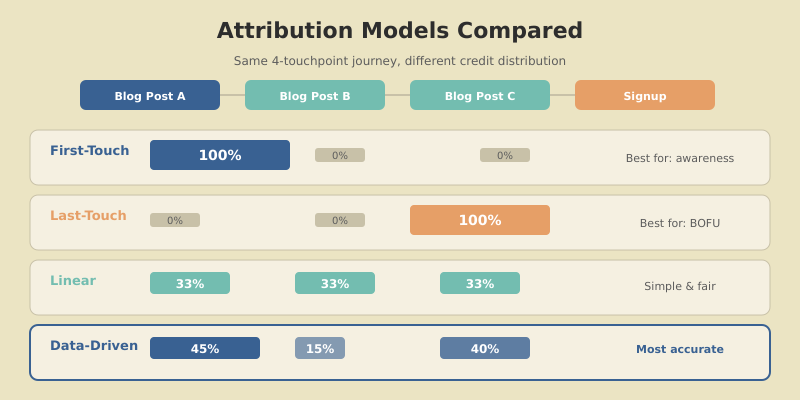
Which article “caused” the signup? All of them contributed. Multi-touch attribution distributes credit across all touchpoints using one of these models:
| Model | Credit Distribution | Best For |
|---|---|---|
| First-touch | 100% to the first content | Measuring awareness content |
| Last-touch | 100% to the last content before signup | Measuring bottom-funnel content |
| Linear | Equal credit to all touchpoints | Simple, fair starting point |
| Data-driven (GA4 default) | ML-weighted by actual impact | Best accuracy (needs 400+ conversions/month) |
GA4’s attribution window limitation
GA4 uses a 30-day lookback window for acquisition and 90 days for engagement conversions. If your average SaaS sales cycle is 120 days, GA4 will miss most of the journey. For long sales cycles, supplement GA4 with CRM-based attribution that stores the full touchpoint history from first visit to close.
The Content Scoring Framework
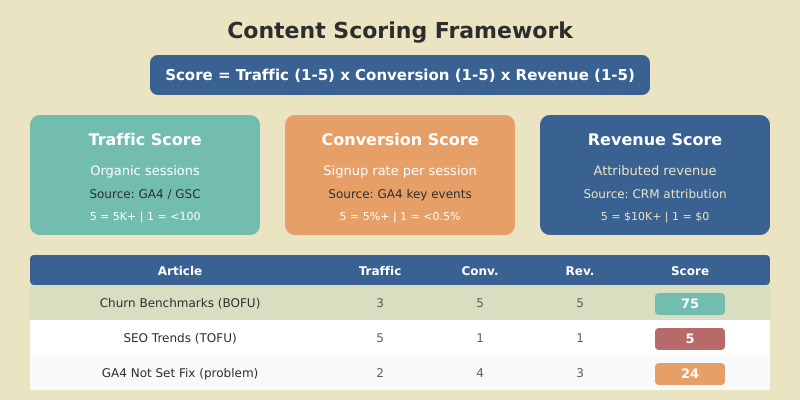
Raw attribution data is useful but overwhelming. To make it actionable, build a content scoring framework that rates each article on three dimensions:
| Dimension | What It Measures | Data Source |
|---|---|---|
| Traffic score | Volume of organic sessions | GA4 / GSC |
| Conversion score | Signup rate per session | GA4 key events |
| Revenue score | Revenue attributed to the content | CRM + attribution |
Score each dimension on a 1–5 scale and multiply: Content Score = Traffic × Conversion × Revenue. A post with high traffic but no conversions scores low. A post with low traffic but exceptional conversion rate and revenue scores high — and tells you to invest in promoting that content more.
This framework, combined with the content hub model from our content marketing strategy guide, gives you a data-driven approach to content investment decisions.
Bottom-of-Funnel Content: The Highest-Converting Asset
As Grow and Convert’s SaaS content research shows, bottom-of-funnel content converts at dramatically higher rates than top-of-funnel thought leadership. Yet most SaaS blogs focus on awareness-stage content because it gets more traffic.
High-converting content types for SaaS:
- Comparison pages — “[Your Product] vs. [Competitor]” — users are actively evaluating
- Use case pages — “How [role] uses [product] for [outcome]” — users are imagining themselves using it
- Integration pages — “[Product] + [Tool they already use]” — users are checking compatibility
- Problem-solution guides — “How to fix [pain point]” — users have an immediate need
- ROI calculators — interactive tools that quantify the value of switching
When I restructured a SaaS client’s content calendar to prioritize bottom-funnel content — spending 60% of effort on BOFU vs. the previous 20% — trial signups from organic content increased 3.2x in four months.
Building the Full Attribution Stack
Here’s the technical stack I recommend for SaaS content attribution:
| Layer | Tool | Purpose |
|---|---|---|
| Analytics | GA4 | Page-level conversion tracking, path analysis |
| Tag management | Google Tag Manager | Event firing, first-touch cookie, hidden form fields |
| CRM | HubSpot / Salesforce | Store first-touch data, connect to revenue |
| Attribution | Dreamdata / HockeyStack / GA4 DDA | Multi-touch modeling, content-to-revenue reporting |
| Reporting | Looker Studio / Spreadsheet | Content scorecard dashboard |
FAQ
How do I track which blog posts drive SaaS trial signups?
Set up GA4 event tracking for your signup event, then use Path Exploration to see which pages users visit before converting. For more detail, create a Free Form Exploration with landing page as rows and signup event rate as values. This shows conversion rate per content piece, not just raw traffic.
What attribution model is best for SaaS content?
Start with first-touch attribution to understand which content starts customer journeys, then add last-touch to see what closes them. If you have 400+ conversions per month, GA4’s data-driven attribution uses machine learning for the most accurate credit distribution across touchpoints.
Why does GA4 miss some content touchpoints in SaaS attribution?
GA4 uses a 30-day lookback window for acquisition and 90 days for engagement conversions. SaaS sales cycles often exceed 90 days, meaning GA4 will miss early touchpoints. Supplement GA4 with first-touch cookies and CRM-based attribution to capture the full journey from first visit to paid conversion.
Should SaaS companies focus content on top-of-funnel or bottom-of-funnel topics?
Bottom-of-funnel content converts at dramatically higher rates despite lower traffic. Prioritize BOFU content — comparison pages, use cases, and problem-solution guides — for direct pipeline impact. Use top-of-funnel content to build topical authority and feed the top of the funnel, but invest more production effort in BOFU pieces.
How do I connect content marketing to actual revenue, not just signups?
Pass first-touch attribution data (landing page, UTM parameters) into your CRM via hidden form fields at signup. When a trial converts to paid, the CRM links the revenue back to the original content touchpoint. This gives you revenue-per-article data instead of just signup counts, which is the real measure of content ROI.
Start Measuring What Matters
Content attribution transforms content marketing from a cost center into a measurable revenue driver. Start with Level 1 — build a GA4 path exploration and a content conversion report. That alone will reveal which of your articles actually drive signups and which are just attracting window shoppers.
Then add first-touch tracking to understand which content starts customer journeys. Finally, connect to your CRM to trace content all the way to revenue. The SaaS companies that invest in this infrastructure make better content decisions, produce higher-ROI content, and can defend their content budget with revenue data instead of traffic charts.
For the broader measurement framework, see our guide on measuring content marketing ROI. And if you need to set up the GA4 event tracking that powers Level 1 attribution, our GA4 event tracking guide for SaaS walks through it step by step.