
Why Content Is Your Best Anti-Churn Weapon
Most SaaS companies treat content marketing as an acquisition channel — blog posts to drive organic traffic and generate signups. But the highest-ROI content you’ll ever produce isn’t for prospects. It’s for customers who are already paying you.
Here’s the math that changed how I think about content priorities: increasing retention by just 5% can boost profits by up to 95%. Meanwhile, up to 75% of SaaS churn happens within the first week if onboarding fails. That means the content you deliver in the first 30 days after signup has more revenue impact than any blog post you’ll ever write.
This guide is a playbook for using content — in-app messages, onboarding sequences, knowledge bases, and feature education — to systematically reduce SaaS churn. It bridges content marketing and customer success, two functions that rarely collaborate but create extraordinary retention results when they do.
The Post-Sale Content Framework
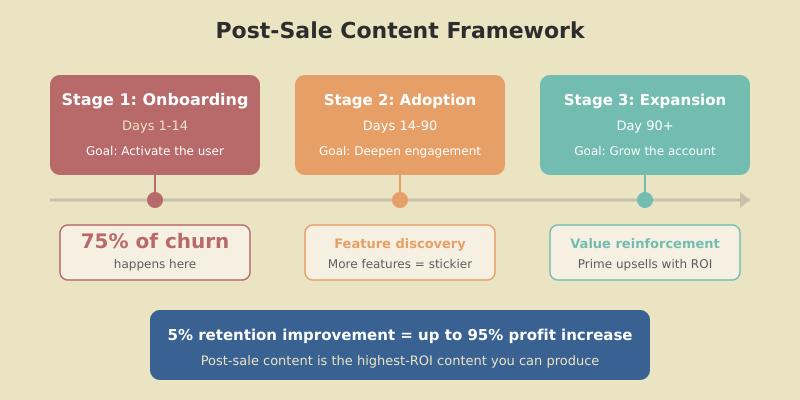
Post-sale content has three distinct jobs, each targeting a different stage of the customer lifecycle:
| Stage | Timeframe | Content Goal | Churn Risk If Missing |
|---|---|---|---|
| Onboarding | Days 1–14 | Activate — get user to the “aha moment” | Critical (75% of churn) |
| Feature adoption | Days 14–90 | Deepen engagement — expand feature usage | High |
| Expansion | Day 90+ | Grow — prime upsells and cross-sells | Medium (silent churn) |
Each stage requires different content types, different delivery channels, and different success metrics. The mistake most teams make is building content for stage 3 (expansion) while ignoring stages 1 and 2, where the actual churn happens.
Stage 1: Onboarding Content (Days 1–14)
The first two weeks determine whether a customer stays or leaves. Your onboarding content has one job: get the user to the activation milestone as fast as possible.
The Onboarding Email Sequence
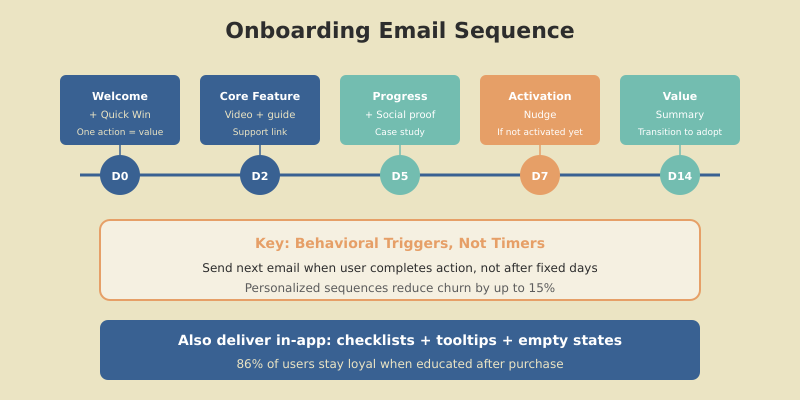
A well-structured onboarding sequence runs 5–7 emails over 14 days. Here’s the framework I’ve used successfully across multiple SaaS products:
Welcome + Quick Win
Welcome the user, set expectations, and guide them to complete one simple action that delivers immediate value. Not a product tour — a result.
Core Feature Introduction
Introduce the one feature that matters most. Link to a short video or step-by-step guide. Include a “stuck?” link to support.
Progress Check + Social Proof
“You’ve set up [feature] — here’s what customers who did this next saw…” Include a case study or stat that reinforces the value of continuing.
Activation Nudge
If the user hasn’t reached the activation milestone, this email directly addresses what’s blocking them. “We noticed you haven’t [action] yet. Here’s a 2-minute guide.”
Value Summary + Next Steps
“In your first 2 weeks, you’ve [achievement]. Here’s what to explore next.” Transition from onboarding to feature adoption content.
Behavioral triggers, not just timers
The best onboarding sequences are behavior-based, not time-based. If a user completes Day 0’s task within an hour, send the Day 2 email immediately — don’t make them wait. If they haven’t completed Day 0’s task after 48 hours, send the nudge instead of the Day 2 content. As Baremetrics’ churn research confirms, personalized onboarding based on behavior reduces churn by up to 15%.
In-App Onboarding Content
Email alone isn’t enough. Users spend more time in your product than in their inbox, so your most impactful onboarding content lives inside the app:
- Onboarding checklists — a visible checklist of 3–5 activation steps with progress tracking. 86% of users say they’re more likely to stay loyal if onboarding content educates them after purchase.
- Contextual tooltips — triggered when a user visits a feature for the first time, explaining what it does and why it matters
- Empty state content — when a dashboard or feature has no data yet, replace the blank screen with instructions and a CTA to take the first action
Stage 2: Feature Adoption Content (Days 14–90)
Once users are activated, the goal shifts from “get them started” to “make them sticky.” Customers who use more features are significantly less likely to churn — they’ve invested time learning your product and woven it into their workflows.
Feature Discovery Campaigns
Most users adopt 2–3 features and never explore the rest. Proactive feature discovery content changes that:
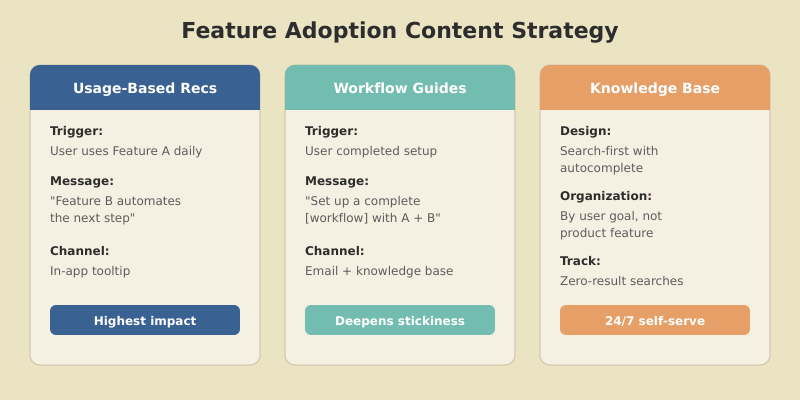
- Usage-based feature recommendations — “You’ve been using [Feature A] daily. Did you know [Feature B] automates the next step?” Trigger these based on actual usage data, not arbitrary timelines.
- Workflow guides — “How to set up a complete [workflow] using [Feature A] + [Feature B].” These show users how features connect into valuable workflows, not just isolated actions.
- Monthly product digests — email highlighting new features, tips for existing features, and power-user techniques. Keep it short (under 300 words) and actionable.
Build a Knowledge Base That Prevents Churn
Your knowledge base isn’t just a support tool — it’s your most scalable retention content. When a user hits a problem at 11 PM, the knowledge base is the difference between solving it (retained) and giving up (churned).
Knowledge base best practices for retention:
- Search-first design — a prominent, intelligent search bar with autocomplete. Users who can’t find answers leave.
- Organized by user goal, not product feature — “How to track conversions” not “Conversion Tracking Module settings”
- Include video walkthroughs — for complex features, a 2-minute video is worth 1,000 words of documentation
- Track search queries with no results — these are gaps in your content that are actively causing frustration
Stage 3: Expansion Content (Day 90+)
After 90 days, retention shifts from preventing churn to building the case for growth. Expansion content doesn’t sell directly — it shows customers value they’re not yet capturing, creating natural demand for upgrades.
Value Reinforcement Content
- Quarterly business reviews (automated) — “This quarter, your team used [Product] to [outcome]. Here’s how you compare to similar companies.” This is content, not sales — but it surfaces expansion opportunities naturally.
- ROI summaries — “You’ve saved 124 hours this quarter with automation. Upgrading to Pro would save an additional 80 hours/quarter.” Quantify the value they’ve already received, then show the gap.
- Case studies from similar customers — “See how [similar company] expanded from your current plan to Enterprise and achieved [result].” Social proof from peers is more persuasive than any sales pitch.
Community and Thought Leadership
Long-term retention depends on customers seeing your company as a partner, not just a vendor. Content that builds this relationship:
- Customer community content — forums, Slack groups, or user conferences where customers learn from each other
- Industry insights — share original research, benchmarks, and trends relevant to your customers’ industry. Our content marketing strategy includes distribution tactics that keep your brand top-of-mind with existing customers.
- Expert webinars — monthly sessions featuring power users sharing advanced techniques
The Content-Churn Metrics Dashboard
Track these metrics to measure whether your retention content is actually reducing churn:
| Metric | What It Measures | Target |
|---|---|---|
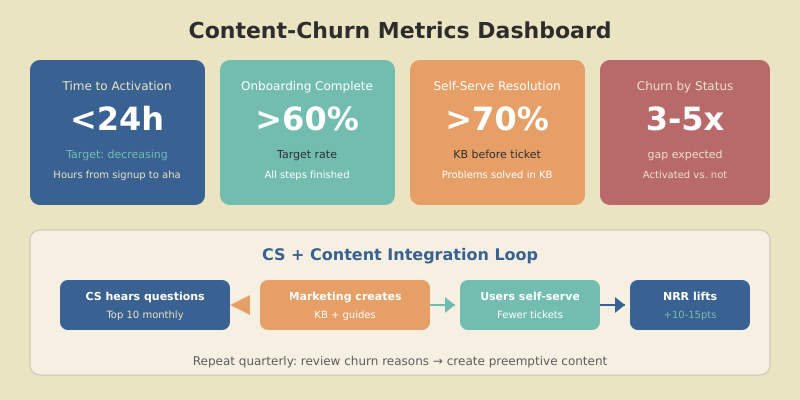
| Time to activation | Hours from signup to activation milestone | Decreasing trend |
| Onboarding completion rate | % of signups completing all onboarding steps | >60% |
| Feature adoption breadth | Avg. features used per active user | Increasing trend |
| KB article views before support ticket | Self-serve resolution rate | >70% self-serve |
| Churn rate by onboarding status | Churn for activated vs. non-activated users | 3–5x difference |
| NRR | Net revenue from existing customers | >110% |
Integrating Content and Customer Success
The biggest unlock I’ve seen in SaaS retention happens when content marketing and customer success stop operating in silos. As Paddle’s retention research documents, teams that integrate marketing content with CS workflows see NRR improvements of 10–15 percentage points within 6 months.
How to integrate:
- CS feeds content gaps to marketing — customer success reps hear the same questions repeatedly. Each repeated question is a content gap. Track the top 10 CS questions monthly and create knowledge base articles or feature guides for each one.
- Marketing provides CS with content assets — give CS reps access to feature guides, case studies, and ROI calculators they can share proactively during check-ins and QBRs
- Shared churn analysis — when a customer churns, CS should document why. Content marketing should review these reasons quarterly and create content that preemptively addresses the top churn drivers.
FAQ
What type of content reduces SaaS churn the most?
Onboarding content that drives users to the activation milestone in the first 14 days has the highest impact on churn reduction. Up to 75% of SaaS churn happens in the first week due to poor onboarding. In-app checklists, behavioral email sequences, and empty-state content are the most effective formats.
How does feature adoption affect SaaS churn rates?
Customers who use more features are significantly less likely to churn because they’ve invested time learning the product and woven it into their workflows. Usage-based feature recommendations, workflow guides, and monthly product digests help expand feature adoption beyond the initial 2–3 features most users discover on their own.
Should onboarding emails be time-based or behavior-based?
Behavior-based onboarding sequences outperform time-based ones. Send the next email when the user completes the current action, not after a fixed number of days. If a user completes setup in an hour, don’t make them wait two days for the next guide. Conversely, if they haven’t completed step one after 48 hours, send a nudge instead.
How can a knowledge base help reduce SaaS churn?
A well-designed knowledge base lets users solve problems independently at any hour. When a user encounters a problem at 11 PM, the knowledge base determines whether they solve it and stay or give up and churn. Organize content by user goals (not product features), add search with autocomplete, and track zero-result searches to find content gaps.
How should content marketing and customer success teams collaborate on retention?
CS should feed repeated customer questions to marketing as content gaps. Marketing should provide CS with feature guides, case studies, and ROI calculators for proactive outreach. Both teams should review churn reasons quarterly and create content that preemptively addresses the top drivers. This integration can lift NRR by 10–15 points within six months.
Build Your Retention Content Engine
Content that reduces churn isn’t a nice-to-have — it’s the highest-ROI content your team can produce. A 5% improvement in retention can double your profits. And unlike acquisition content, retention content compounds: every customer you keep generates more revenue, more referrals, and more expansion opportunities.
Start with the onboarding sequence — it addresses 75% of churn risk in the first 14 days. Then build your knowledge base around the top CS questions. Finally, create feature adoption campaigns that deepen engagement beyond the initial use case.
For the broader retention and growth context, see our SaaS growth strategy guide and churn rate benchmarks. To understand how retention content connects to your content marketing strategy and ROI measurement, those guides cover the full picture.