What Are PLG and Sales-Led Growth?
Product-led growth (PLG) is a go-to-market strategy where the product itself drives acquisition, conversion, and expansion. Users sign up, experience value, and upgrade — often without ever talking to a salesperson. Think Slack, Notion, or Calendly: you try the free version, get hooked, and eventually pay.
Sales-led growth (SLG) puts the sales team at the center of the customer journey. Prospects go through demos, discovery calls, negotiations, and contract reviews before they ever touch the product. Enterprise SaaS companies like Salesforce and Workday built empires on this model.
The distinction matters because it shapes everything downstream — your pricing, your team structure, your metrics, and your entire SaaS growth strategy. I’ve helped SaaS companies implement both models, and choosing wrong doesn’t just slow you down — it can burn through your runway before you find product-market fit.
PLG vs. Sales-Led: Quick Comparison
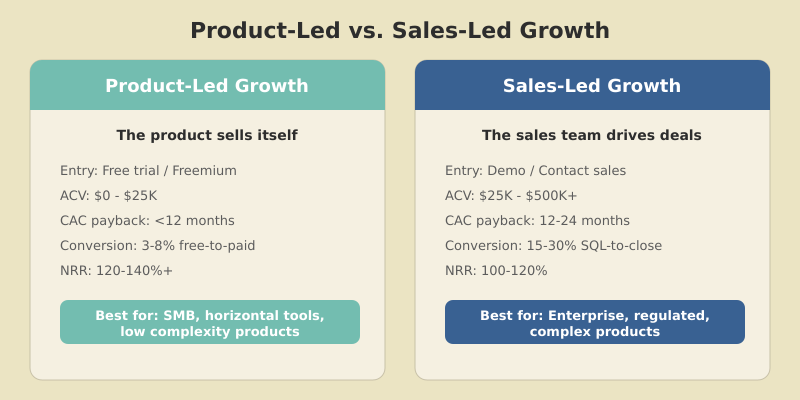
| Dimension | Product-Led (PLG) | Sales-Led (SLG) |
|---|---|---|
| Primary driver | Product experience | Sales team |
| Entry point | Free trial / Freemium | Demo request / Contact sales |
| Typical ACV | $0–$25K | $25K–$500K+ |
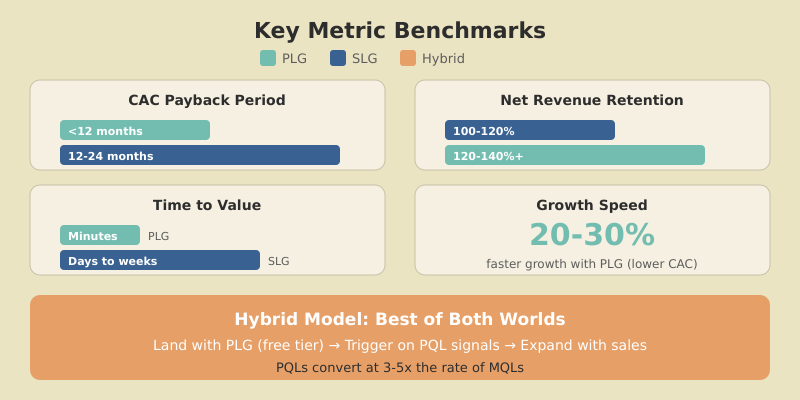
| CAC payback | <12 months | 12–24 months |
| Free-to-paid conversion | 3–8% (median) | N/A (SQL→close 15–30%) |
| NRR benchmark | 120–140%+ | 100–120% |
| Growth speed | 20–30% faster (lower CAC) | Slower start, bigger deals |
| Best for | SMB, horizontal tools | Enterprise, regulated industries |
How Product-Led Growth Works
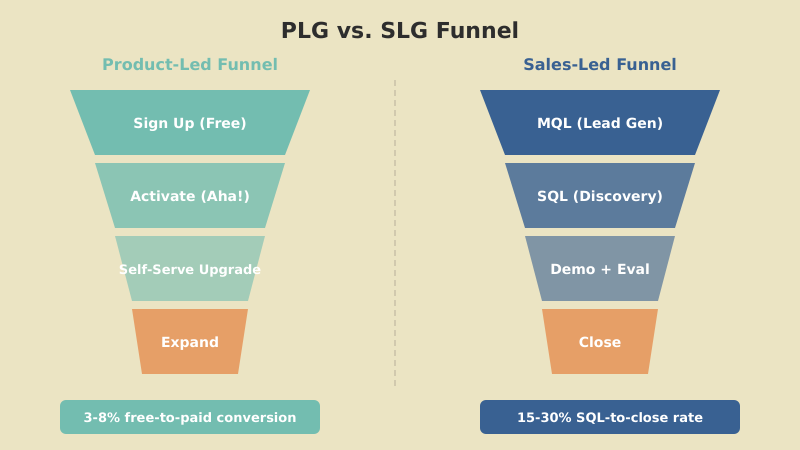
In a PLG model, the product is the primary vehicle for acquiring, activating, and retaining customers. The funnel looks like this:
- Acquisition — users discover the product through organic search, word-of-mouth, or content marketing (often product-led SEO)
- Activation — users sign up for a free tier or trial and experience the core value within minutes
- Revenue — users hit usage limits or discover premium features and self-serve upgrade
- Expansion — existing users invite teammates, creating viral loops and seat-based expansion
The magic of PLG is that satisfied users become your sales force. When a product manager at a mid-size company discovers your tool, uses it successfully, and then introduces it to their team — that’s bottom-up adoption, and it’s incredibly capital-efficient.
PLG by the numbers
PLG companies grow 20–30% faster on average due to lower customer acquisition costs, according to OpenView’s Product Benchmarks report. But only 9% of free accounts upgrade to paid — so you need massive top-of-funnel volume to make the economics work.
When PLG Works Best
- Low complexity products — users can experience value without training or configuration
- Individual end-users as buyers — the person using the product can also purchase it
- Low ACV ($0–$25K) — the deal size doesn’t justify a dedicated sales process
- Network effects — the product gets more valuable as more people in a team use it
- Horizontal use cases — tools that work across industries (project management, communication, design)
How Sales-Led Growth Works
In an SLG model, the sales team controls the customer journey from first touch to signed contract. The funnel:
- Lead generation — marketing creates MQLs through content, events, paid ads
- Qualification — SDRs qualify leads into SQLs through discovery calls
- Demo and evaluation — AEs run product demos tailored to the prospect’s needs
- Negotiation and close — contracts, security reviews, procurement, legal
- Onboarding — customer success team ensures successful deployment
SLG is consultative — the sales team doesn’t just process orders, they diagnose problems and position your product as the solution. This is critical when the buyer isn’t the end-user (a VP of Engineering buying for their team) or when the purchase requires organizational change.
SLG strength: onboarding and activation
Sales-led companies show a 26.7% core feature adoption rate vs. 24.3% for PLG, as Userpilot’s SaaS product metrics research shows — likely because hands-on onboarding ensures users actually learn the product, rather than bouncing during self-serve exploration.
When SLG Works Best
- Complex products — require configuration, integrations, or training before value delivery
- High ACV ($25K+) — the deal size justifies dedicated sales resources
- Enterprise buyers — procurement processes, security reviews, and legal teams are involved
- Regulated industries — healthcare, finance, and government have compliance demands that require human guidance
- Multi-stakeholder decisions — when the buying committee includes 5+ people, you need a salesperson to navigate it
The Decision Framework: 5 Questions to Ask
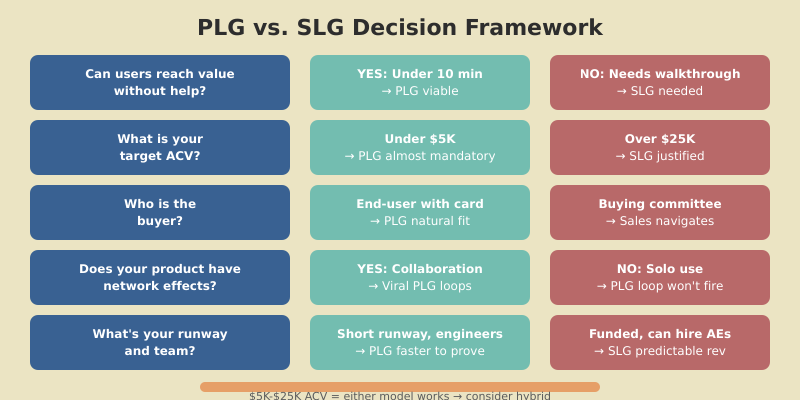
I’ve helped SaaS teams evaluate this choice more times than I can count. Every time, the decision comes down to these five factors:
Can users reach the “aha moment” without help?
If users can sign up and experience core value in under 10 minutes with no guidance, PLG is viable. If they need a 30-minute walkthrough, you need sales involvement. Canva is a “yes” — you create a design within minutes. Snowflake is a “no” — setting up a data warehouse requires configuration and expertise.
What’s your target ACV?
Below $5K ACV, PLG is almost mandatory — the unit economics don’t support sales salaries. Between $5K–$25K, either model works. Above $25K, sales involvement typically increases win rates enough to justify the cost. Above $100K, dedicated enterprise sales is standard.
Who is the buyer?
If the end-user can swipe a credit card and start using the product, PLG is natural. If purchasing requires VP approval, procurement review, and IT security sign-off, you need sales to navigate the buying committee.
Does your product have network effects?
Products that get better as more people use them (Slack, Figma, Miro) are natural PLG candidates. Each new user creates viral pull for more users. If your product is used individually with no collaboration component, PLG’s viral loop won’t fire.
What’s your current runway and team?
PLG requires significant product and engineering investment upfront (self-serve onboarding, usage tracking, billing). SLG requires hiring sales reps. If you have 6 months of runway and 3 engineers, PLG is faster to prove. If you have funding and can hire 2 AEs, SLG delivers more predictable revenue.
The Hybrid Model: Why Most SaaS Companies Need Both
Here’s what I’ve learned working with growth-stage SaaS companies: the PLG-vs-SLG debate is increasingly a false dichotomy. By 2026, the most successful SaaS companies use a hybrid approach — landing with PLG and expanding with sales.
The pattern looks like this:
| Stage | Motion | Example |
|---|---|---|
| Land | PLG — free tier or trial | Individual signs up, uses product for free |
| Trigger | Product-qualified lead (PQL) | User hits usage threshold or invites 5+ teammates |
| Engage | Sales outreach — warm, data-driven | AE contacts account admin with upgrade proposal |
| Expand | Sales + CS — enterprise contract | Team plan → department license → company-wide deal |
Slack, Zoom, Datadog, and Atlassian all followed this playbook. As Paddle’s PLG analysis documents, companies that successfully combine self-serve acquisition with enterprise sales consistently outperform pure-play models. They acquired millions of free users through product-led growth, then layered on sales teams to convert the most promising accounts into enterprise contracts. The product does the heavy lifting at the bottom of the market; sales captures the high-value deals at the top.
The key metric for hybrid models: Product-qualified leads (PQLs). Unlike MQLs (who downloaded a whitepaper), PQLs have already used your product and demonstrated buying intent through usage behavior. PQLs convert to paid at 3–5x the rate of MQLs because the user has already experienced value.
PLG Metrics vs. SLG Metrics: What to Track
The growth model you choose determines which metrics run your business. Tracking the wrong metrics for your model will give you a false picture of health.
| Metric | PLG Benchmark | SLG Benchmark |
|---|---|---|
| Signup → activation | 25–40% | N/A (onboarding-driven) |
| Free → paid conversion | 3–8% | N/A |
| SQL → close rate | N/A | 15–30% |
| CAC payback period | <12 months | 12–24 months |
| Net revenue retention | 120–140%+ | 100–120% |
| Time to value | Minutes to hours | Days to weeks |
| Feature adoption rate | 24.3% | 26.7% |
| Expansion mechanism | Viral loops, seat-based | Upsell, cross-sell by CS/AE |
Notice that net revenue retention tends to be higher in PLG — that’s because expansion revenue from seat-based growth and usage increases is baked into the product experience. SLG expansion depends on proactive sales and customer success outreach, which is harder to scale.
Real-World Examples: PLG, SLG, and Hybrid
Pure PLG: Calendly
Calendly is a textbook PLG success story. Every time someone sends a scheduling link, the recipient sees the product in action. That viral loop drove Calendly to $100M+ ARR with minimal sales investment. The product is simple enough that users experience value in under 60 seconds — a critical requirement for PLG.
Pure SLG: Veeva Systems
Veeva sells cloud software to pharmaceutical companies — a heavily regulated industry where purchasing decisions involve compliance officers, IT security, and C-suite executives. Self-serve signup would be meaningless here. The sales cycle is 6–12 months, ACV is $500K+, and every deal requires deep domain expertise. SLG is the only viable model.
Hybrid: Slack
Slack’s journey perfectly illustrates the hybrid evolution. It launched as a free product with viral adoption — teams signed up, used it, and spread it organically. But when enterprise accounts started emerging, Slack built a sales team to capture those deals. Today, Slack’s largest contracts come through enterprise sales, while the free tier continues to feed the top of the funnel. The product lands; sales expands.
How to Transition Between Models
Most SaaS companies don’t pick the right model on day one. Here’s what transitions typically look like:
Adding Sales to PLG (Most Common)
When your PLG motion generates thousands of free users but struggles to convert enterprise accounts, it’s time to add a sales layer. The playbook:
- Define PQL criteria — which usage signals indicate enterprise buying intent? (10+ users, hitting API limits, using advanced features)
- Hire 2 AEs, not 20 — start small, prove the motion works, then scale
- Don’t gate the product — keep the free tier. Your sales team should reach out to warm PQLs, not cold leads
- Build an enterprise tier — with features self-serve users don’t need: SSO, audit logs, admin controls, SLA
Adding PLG to SLG (Harder, but Increasingly Necessary)
Enterprise-first SaaS companies adding self-serve tiers face different challenges:
- Simplify the product — create a version that delivers value without configuration or onboarding
- Build self-serve billing — this is often the hardest part for companies used to manual contracts
- Separate the motions — don’t let the self-serve tier cannibalize enterprise deals. Use usage-based pricing that naturally upgrades to sales-assisted at higher volumes
- Invest in product analytics — you need usage data to identify PQLs. Most SLG companies lack this instrumentation
FAQ
Is product-led growth better than sales-led growth?
Neither is inherently better. PLG is more capital-efficient for low-ACV, simple products with individual end-user buyers. SLG is essential for high-ACV, complex products sold into enterprise. Most successful SaaS companies eventually use a hybrid of both approaches.
What is a good free-to-paid conversion rate for PLG?
The median free-to-paid conversion rate is about 3–5%, with top performers reaching 8–10%. Credit card-required trials convert 5x higher than freemium models. Focus on activation rate first — users who reach the “aha moment” convert at much higher rates.
Can a SaaS company switch from sales-led to product-led?
Yes, but it requires significant product investment to simplify onboarding, build self-serve billing, and instrument usage analytics. The most common approach is adding a PLG tier alongside the existing sales motion rather than fully replacing it. This transition typically takes 6–12 months.
What is a product-qualified lead (PQL)?
A PQL is a user who has demonstrated buying intent through product usage — such as hitting usage limits, inviting teammates, or using premium features. PQLs convert to paid at 3–5x the rate of marketing-qualified leads (MQLs) because they’ve already experienced the product’s value firsthand.
How do PLG companies drive expansion revenue?
PLG expansion comes primarily from seat-based growth (users inviting teammates), usage-based pricing (paying more as usage increases), and feature upgrades (moving from free to premium tiers). Leading PLG companies achieve 120–140%+ net revenue retention through these organic expansion mechanisms.
Choose the Model That Matches Your Market
The PLG vs. SLG decision isn’t about which model is trendier — it’s about matching your go-to-market motion to your product’s complexity, your buyer’s behavior, and your deal size. PLG gives you capital-efficient growth with viral potential. SLG gives you predictable revenue and enterprise-grade deal sizes. Hybrid gives you both, at the cost of organizational complexity.
Start by answering the five questions in the decision framework above. If your product can deliver value in under 10 minutes, your ACV is below $25K, and end-users can buy without committee approval — lead with PLG. Otherwise, invest in sales first and add self-serve later.
Whatever model you choose, the fundamentals of SaaS growth strategy still apply — you need strong retention, healthy unit economics, and a clear path to expansion revenue. The growth model is how you acquire customers; retention and expansion are how you keep and grow them.