
How to Optimize for Google AI Overviews (AIO): A Practical Guide
Google AI Overviews optimization isn’t optional anymore — it’s the new front line of search visibility. If you’ve been watching your organic traffic dip on informational queries and can’t figure out why, AI Overviews are likely the answer. Google now generates AI-powered summaries at the top of search results for a growing slice of queries, and those summaries are reshaping where clicks go.
When AI Overviews rolled out broadly in mid-2024, one of my SaaS clients saw a 23% drop in organic traffic to their top informational pages within 8 weeks. We restructured their content using the QAE framework, added schema markup, and within 3 months their pages were being cited in AI Overviews — and traffic recovered to 94% of the original level.
That experience taught me something critical: the brands that adapt their SEO strategy to account for AI Overviews won’t just survive this shift — they’ll gain ground while competitors scramble. In this guide, I’ll walk you through exactly how to do that, step by step.
What You’ll Learn
What Are Google AI Overviews (And Why Should You Care)?
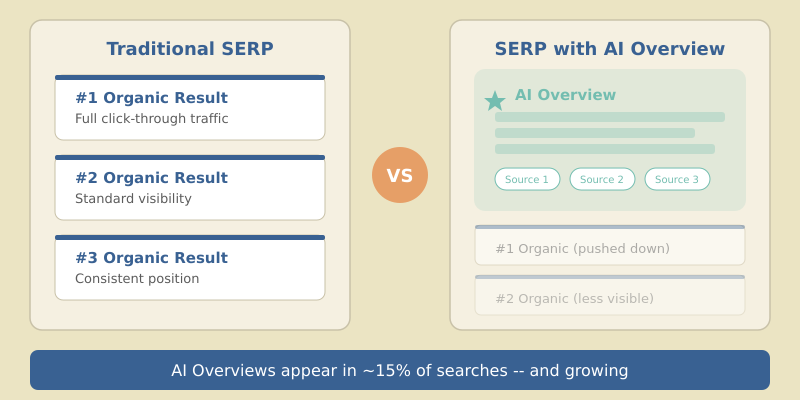
AI Overviews (previously called Search Generative Experience or SGE) are AI-generated summaries that appear at the top of Google search results. When you search something like “how to reduce SaaS churn,” instead of jumping straight to ten blue links, Google synthesizes an answer from multiple sources and presents it in a rich, expandable panel — complete with citations linking to the pages it drew from.
Unlike featured snippets, which pull one block from one page, AI Overviews synthesize information from multiple sources simultaneously. Google’s AI reads dozens of pages, extracts relevant points, and creates a blended response with source citations.
As of mid-2025, AI Overviews appear in roughly 13-19% of all searches according to Ahrefs research, climbing steadily since the initial rollout. For informational and how-to queries, the percentage is even higher.
A Seer Interactive study from September 2025 found that organic CTR drops 61% for queries where AI Overviews appear. Paid CTR drops 68%. Zero-click searches rose from 56% to 69% between May 2024 and May 2025.
But here’s the flip side: brands cited in AI Overviews earn 35% more organic clicks than from a standard result. Being a named source gives you credibility and click gravity that traditional rankings alone can’t match.
How Google Selects Sources for AI Overviews
Understanding the selection mechanism is essential before you start optimizing. Google hasn’t published a formal algorithm for AIO sourcing, but Google Search Central has shared guidance on succeeding in AI-powered search, and independent research has revealed clear patterns. Three signals dominate.
Content Quality Signals
Google’s AI looks for content that demonstrates direct experience, provides specific and verifiable information, and answers questions comprehensively. Pages cited in AI Overviews share key traits: clear heading structure, specific data points, genuine expertise (not repackaged information), and up-to-date content.
This is where high-quality content strategy becomes non-negotiable. Content that merely summarizes other articles rarely gets cited — original research, real examples, and practitioner insights are what the AI gravitates toward.
Structured Data and Schema
Structured question-and-answer markup gives Google’s AI a machine-readable map of your content. Note that Google retired the FAQ rich result in search on 7 May 2026 — the markup keeps its parsing value, not its snippet. Structured data gives the AI a machine-readable map of your content — it can identify questions and answers, steps in a process, and key entities without guessing.
The schema types that matter most for AIO are:
- FAQPage — marks up questions and answers explicitly
- HowTo — defines step-by-step processes with tools and materials
- Article / BlogPosting — provides metadata about the content type, author, and publish date
You don’t need to implement all of them on every page, but FAQ schema should be your baseline for any informational content.
Topical Authority
Google’s AI doesn’t just evaluate individual pages — it evaluates your site’s overall depth on a topic. A single blog post about “SaaS churn” on a site that otherwise covers cooking recipes won’t carry the same weight as the same article on a site with a full cluster of SaaS content.
This is topical authority in action, and it’s arguably the hardest signal to build because it requires consistent publishing around a focused set of topics. Sites that organize content into clear topic clusters — with pillar pages linking to supporting articles — send strong signals about depth and expertise. It’s a principle that sits at the heart of any solid SEO strategy.
We want to show information from pages that demonstrate experience and expertise. This is especially important for AI Overviews, where we want to surface helpful, reliable content from people who genuinely understand the topic.
The QAE Framework: Question, Answer, Expand
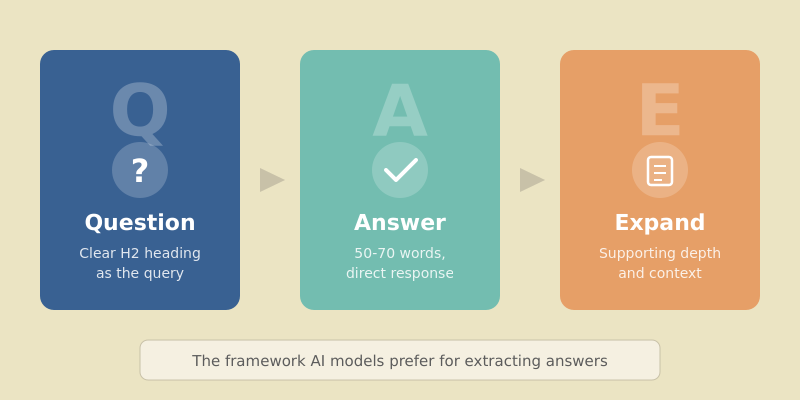
After testing dozens of content structures across client sites, I’ve settled on a framework I call QAE — Question, Answer, Expand. It’s simple, but it consistently produces content that Google’s AI can extract and cite cleanly.
Here’s how it works:
- Question — Start each major section with the question your audience is actually asking. Use it as or near the heading. This gives Google’s AI a clear signal about what the section addresses.
- Answer — Immediately provide a direct, concise answer in 50-70 words. No preamble, no “great question!” — just the answer. This is the snippet-ready block that AI Overviews are most likely to extract.
- Expand — After the direct answer, go deep. Add context, examples, data, nuance, and caveats. This is where you demonstrate expertise and differentiate from every other article covering the same ground.
Before (typical blog structure):
“In today’s digital landscape, it’s really important to think about structured data. There are many types of structured data, and each has its own benefits. Let’s explore why structured data matters for SEO and how you can use it on your website to improve your rankings…”
After (QAE structure):
Does structured data help with AI Overviews?
Yes — structured data gives Google’s AI a machine-readable map of your content, making it easier to extract specific answers, steps, and facts for inclusion in the overview panel.
Here’s why this works: AI Overviews need to identify discrete, citable pieces of information. When your page has FAQ schema, each question-answer pair is explicitly labeled. The AI doesn’t have to guess where your answer begins and ends…
The difference is stark. The “before” version buries the answer under filler. The “after” version delivers the answer immediately, then earns trust by going deeper. Google’s AI can extract that first paragraph cleanly, cite your page, and move on.
Structure every informational section using QAE. Lead with the question, deliver a 50-70 word direct answer, then expand with expertise. This single change made the biggest difference across every client site I’ve optimized for AI Overviews.
Seven Tactics for Google AI Overviews Optimization
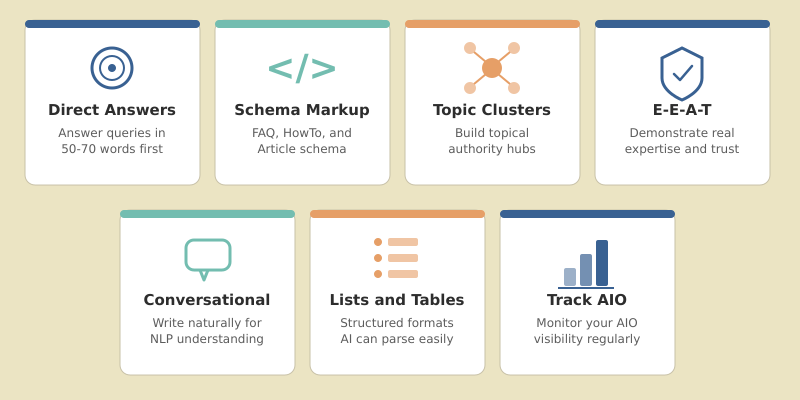
Now let’s get into specifics. These are the seven tactics that have produced measurable results across the sites I work on. They’re ordered by impact — start with the first two and work your way down.
1. Lead With Direct Answers
Every page targeting an informational query should answer the core question within the first 150 words. People who get a fast, credible answer trust you more and keep reading for details.
Apply the QAE framework to each section. Google’s AI looks for clear, extractable answer blocks, and content higher on the page gets weighted more heavily.
- Put your primary answer in the first paragraph under each H2
- Keep that first paragraph between 50-70 words
- Use clear, declarative sentences — avoid hedging language
- Follow with detailed explanation, examples, and data
2. Implement Structured Data Markup
Structured data is the single most underused lever for AIO optimization. Here’s your priority list:
FAQ schema — add it to every article with a FAQ section. You can mark up question-answer pairs throughout the article, not just in a dedicated FAQ section.
HowTo schema — use it for step-by-step guides with steps, estimated time, and tools needed. Google’s AI pulls heavily from HowTo markup because it maps cleanly to AIO format.
Article schema — ensure your CMS generates proper BlogPosting or Article schema with author, publish date, and headline.
Validate your markup with Google’s Rich Results Test. Invalid schema is worse than no schema.
3. Build Topic Clusters, Not Isolated Pages
Publishing a single article about “AI Overviews” won’t signal expertise to Google. Publishing a cluster of related articles — covering AI Overviews, Generative Engine Optimization (GEO), E-E-A-T, topical authority, and technical SEO — demonstrates that you understand the broader landscape.
The concept of Generative Engine Optimization (GEO) extends beyond Google to include AI platforms like ChatGPT, Perplexity, and Gemini. While the fundamentals overlap with AI Overviews optimization, GEO addresses the unique dynamics of being cited across multiple AI systems — each with different citation logic and source preferences.
For topic clusters to work for AIO:
- Create one comprehensive pillar page per core topic
- Build 5-8 satellite articles that go deep on subtopics
- Interlink everything — satellites link to the pillar, pillar links to satellites, and related satellites link to each other
- Use consistent terminology across the cluster so the AI can recognize topical relationships
4. Strengthen Your E-E-A-T Signals
Google has been explicit: Experience, Expertise, Authoritativeness, and Trustworthiness are central to how it evaluates content for AI Overviews. This isn’t abstract — there are concrete things you can do.
Experience: Include first-person accounts. “When I tested this on a client’s site” carries more weight than “studies show.” Share specific results with real numbers.
Expertise: Demonstrate deep knowledge. Use precise terminology (but explain it). Show your work — explain why something works, not just that it does.
Authoritativeness: Get cited by other sites. Build a professional author page with credentials. Publish consistently on your topic.
Trustworthiness: Be honest about limitations. Cite sources with inline links. I’ll be the first to admit that AIO optimization is still evolving, and what works today may shift as Google refines its algorithms.
The sites that consistently appear in AI Overviews share a pattern: they demonstrate real-world experience, back their claims with data, and build genuine authority through depth — not volume. You can’t fake expertise at scale when AI is evaluating your content.
5. Optimize for Conversational Queries
AI Overviews are most commonly triggered by conversational, question-based searches. People type “how do I get my content into Google AI Overviews” — not stiff keyword phrases.
- Research “People Also Ask” boxes for your target topics
- Use question-format headings (H2s and H3s)
- Write the way your audience talks — natural language
- Cover follow-up questions that naturally flow from the main query
Use GA4 and Google Search Console together to identify which conversational queries already bring traffic, then build content that answers those questions more directly.
6. Use Lists, Tables, and Step-by-Step Formats
AI Overviews favor structured content because it’s easy to parse and extract cleanly.
Formats that perform well in AIO:
| Format | Best For | AIO Extraction Rate |
|---|---|---|
| Numbered lists | Step-by-step processes | High |
| Bullet points | Features, pros/cons | High |
| Tables | Comparisons, data | Very high |
| Definition blocks | Glossary terms, concepts | Moderate |
| Before/after examples | Demonstrations | Moderate |
Mix formats throughout your content. Lists for multiple items, tables for comparisons, step-by-step blocks for processes. Each gives Google’s AI a different way to extract and present your information.
7. Monitor and Measure Your AIO Presence
You can’t optimize what you don’t measure. Tracking your AIO presence needs to become a separate KPI alongside traditional rankings and traffic.
Here’s how to set up tracking:
- Google Search Console — monitor impression and CTR changes on informational queries. A sudden drop in CTR without a ranking change often signals that an AI Overview appeared.
- Manual spot-checks — search your top 20 keywords weekly in an incognito browser. Note which queries trigger AI Overviews and whether your site is cited.
- Third-party tools — platforms like Semrush, Ahrefs, and BrightEdge are building AIO tracking features. These let you monitor at scale.
- Citation tracking — when your page appears as a source in an AI Overview, track the impact on traffic and engagement for that specific page. Look at both the source link clicks and downstream behavior.
Baseline
-61%
+35% vs. Standard
What NOT to Do (Common Mistakes)
I see these mistakes constantly, even from experienced SEOs who should know better. AI Overviews require a different mindset than traditional optimization, and old habits can actively hurt you.
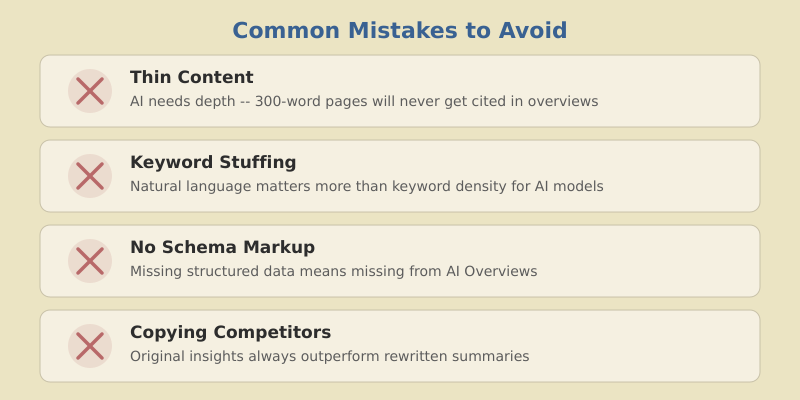
Mistake 1: Publishing thin content to hit page count. If you’re churning out 500-word articles to cover more keywords, stop. Google’s AI can tell when content is shallow. It actively avoids citing pages that don’t add unique value. One thorough article outperforms five thin ones every time.
Mistake 2: Keyword stuffing. Repeating your target phrase ten times won’t get you cited in AI Overviews. Google’s AI understands semantic relevance — it doesn’t need exact-match repetition. Write naturally and cover the topic comprehensively.
Mistake 3: Ignoring structured data. I’ve audited sites with hundreds of informational articles and zero schema markup. They’re leaving citations on the table. Marking up your questions and answers makes them easier for machines to extract. The implementation takes minutes per page.
Mistake 4: Treating AI Overviews like featured snippets. Featured snippets pull one block from one page. AI Overviews synthesize from multiple sources. You can’t format one perfect paragraph and “win” the AIO box — you need comprehensive, authoritative content the AI trusts enough to cite.
Mistake 5: Ignoring brand signals. AI Overviews don’t just evaluate your page — they evaluate your brand. Sites with strong brand recognition, consistent publishing history, and citations across the web get cited more often. Build your brand presence beyond just your website.
Mistake 6: Setting it and forgetting it. The AIO landscape changes monthly. Search Engine Land has tracked these ongoing changes extensively. What earned you a citation last month might not work next month.
The biggest mistake is treating AIO optimization as a one-time project. It’s an ongoing practice that requires monitoring, adaptation, and a commitment to genuine content quality over shortcuts. Build systems to track your progress, and revisit your approach quarterly at minimum.
Frequently Asked Questions
Conclusion
Google AI Overviews optimization comes down to a fundamental shift in how you think about content. Instead of writing for rankings alone, you’re writing for citation — creating content so well-structured, so authoritative, and so directly useful that Google’s AI can’t build a comprehensive answer without including you.
Start with the highest-impact moves: restructure your existing top-performing content using the QAE framework, implement FAQ schema across your informational articles, and begin tracking AIO presence as a dedicated metric. Then build from there with topic clusters, enhanced E-E-A-T signals, and multi-format content.
The zero-click trend is real — 56% to 69% in a single year. But that same trend creates opportunity for brands that appear inside AI-generated answers. Being cited positions you as a trusted source at the top of the page, above every traditional result.
The brands that adapted early are seeing stronger results than before AI Overviews existed. The ones that ignored it are still watching traffic decline. The choice is straightforward — and the time to act is now.