
Content Marketing Strategy: The Complete Playbook for SaaS and B2B
Most content marketing guides treat your blog like a magazine. Publish consistently, rank for keywords, and hope the audience shows up. That model is dead — especially in B2B and SaaS.
I’ve spent the last decade helping SaaS companies build content programs that actually drive pipeline. The ones that win don’t publish more. They publish smarter, distribute relentlessly, and instrument everything. This guide is the playbook I wish I’d had at the start.
Here you’ll learn how to build a content marketing strategy from scratch: what to audit, how to plan your topic architecture, how to create content at scale without sacrificing quality, how to distribute it, and — critically — how to measure whether any of it is working.
Table of Contents
- What Is Content Marketing Strategy (and Why Most Fail)
- The Content Marketing Framework: Audit, Plan, Create, Distribute, Measure
- Building Your Content Engine: Topic Clusters and Pillar Pages
- Content Creation at Scale: Quality vs. Quantity in the AI Era
- The Distribution Playbook: Getting Content in Front of the Right People
- Content Marketing for SaaS: From Awareness to Pipeline
- Measuring Content ROI: Metrics That Actually Matter
- Frequently Asked Questions
Those numbers come from the Content Marketing Institute’s annual research, and they’ve been consistent for years. The opportunity is real. The execution gap is real too. Let’s close it.
What Is Content Marketing Strategy (and Why Most Fail)
Content marketing strategy is the documented plan for using content to attract, engage, and convert a specific audience — and to measure the business impact of doing so. It’s not a content calendar. It’s not a keyword list. It’s a system.
The “strategy” is the part most teams skip. They jump straight to production: write blogs, post on LinkedIn, send newsletters. Then, six months later, leadership asks what it’s producing, and nobody has a good answer.
Here’s why most B2B content programs fail:
- No defined audience — they write for everyone, so they resonate with no one
- No content architecture — random topics with no topical depth or internal linking
- No distribution plan — publish and pray, then wonder why traffic doesn’t grow
- No measurement — vanity metrics like pageviews masquerade as success
- Misaligned goals — content team chasing traffic while sales needs demos
The fix isn’t more content. It’s a coherent strategy that connects every piece of content to a business outcome. That’s what we’re building here.
Content marketing is the only marketing left. Everything else is just advertising.
Founder, Content Marketing Institute
The B2B/SaaS Content Reality
B2B buyers behave differently from consumers. They spend weeks or months researching decisions. They share content internally. They trust peer recommendations and third-party evidence more than brand messaging. And they often reach your sales team already 70% through their decision process, having done research you had no visibility into.
This means your content has to do heavy lifting at every stage — building awareness before anyone knows they have a problem, educating during consideration, and eliminating objections at the point of decision. That’s a fundamentally different content job than “drive traffic and hope.”
The Content Marketing Framework: Audit, Plan, Create, Distribute, Measure
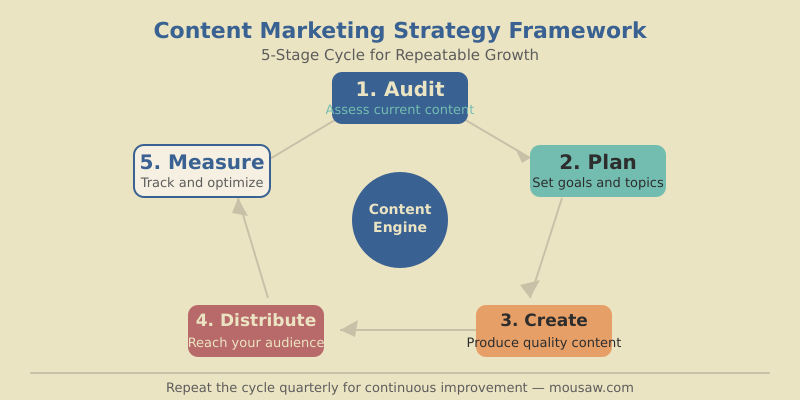
Every mature content program runs on a five-stage cycle. You don’t do it once — you iterate it quarterly. Here’s what each stage means in practice.
| Stage | Key Questions | Primary Output |
|---|---|---|
| Audit | What do we have? What’s working? What’s hurting us? | Content inventory + gap analysis |
| Plan | What should we create? For whom? In what order? | Content roadmap + topic cluster map |
| Create | How do we produce quality at scale without burning out? | Published content assets |
| Distribute | Who needs to see this? Where are they? How do we reach them? | Multi-channel distribution plan |
| Measure | Is this actually working? What should we do more of? | Performance report + next cycle input |
Stage 1: The Content Audit
Before you create a single new piece, audit what you already have. Most B2B companies have a graveyard of old blog posts, landing pages, and ebooks — content that either isn’t indexed properly, cannibalizes other pages, or ranks for nothing useful.
A proper content audit asks three questions about every piece: Does it rank? Does it convert? Does it help the buyer? If a page scores “no” on all three, it’s dead weight. Consolidate, redirect, or delete it.
In my experience working with SaaS clients, a content audit typically reveals that 20% of pages drive 80% of organic traffic. The other 80% need to be updated, merged, or culled. That’s a massive opportunity hiding in plain sight.
Stage 2: Planning Your Content Roadmap
Audience definition comes first. In B2B and SaaS, “your audience” usually means 2-4 buyer personas at different seniority levels. An ICP (Ideal Customer Profile) isn’t enough — you need to know what each persona searches for, what objections they carry, and what content format they actually consume.
Then map content to the buyer journey: top-of-funnel awareness content, middle-of-funnel education content, and bottom-of-funnel decision content. SaaS companies often over-invest in TOFU blog content and neglect the comparison pages, case studies, and technical documentation that close deals. For product-led companies, product-led SEO adds another dimension: aligning every content piece with a self-serve signup path so the content itself drives acquisition.
A content roadmap isn’t a content calendar. A calendar tracks when things publish. A roadmap maps content to business outcomes, buyer stages, and topic clusters — and gets updated based on what the data shows.
Building Your Content Engine: Topic Clusters and Pillar Pages
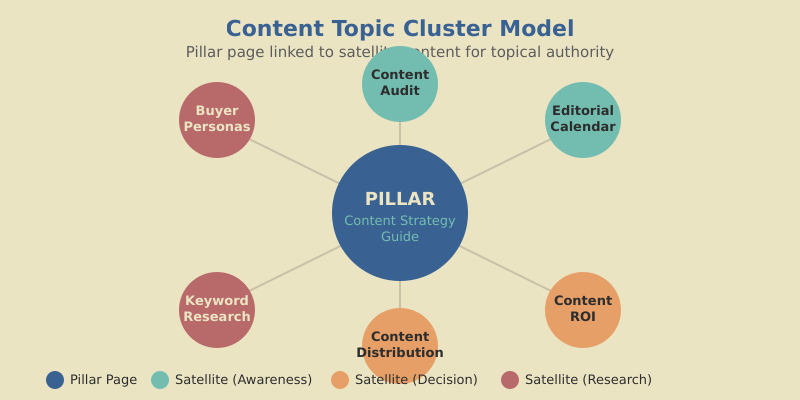
The shift from “write blog posts” to “build topical authority” is the single biggest unlock in modern content marketing. And it all comes down to the topic cluster model.
Here’s the structure: you have one comprehensive pillar page that covers a broad topic in depth. Around it, you build a cluster of satellite articles, each covering a specific subtopic in more detail. Every satellite links back to the pillar. The pillar links out to every satellite. This creates a tight internal linking network that signals topical authority to Google — and gives readers a clear navigation path through your content.
I covered this architecture in detail in my SEO strategy guide, but here’s the content marketing angle: topic clusters aren’t just an SEO tactic. They’re a content planning framework. They force you to think about a topic completely before you start producing, instead of writing whatever seems interesting this week.
How to Choose Your Pillar Topics
Your pillar topics should sit at the intersection of three things: what your audience cares about most, what you can credibly own, and where there’s commercial intent that eventually leads to your product or service. For a SaaS company in the analytics space, “Google Analytics 4” is a pillar topic. For a content marketing agency, “content marketing strategy” is the pillar.
Each content hub should have 6-10 satellites covering variations, use cases, and adjacent subtopics. Semrush’s content research data consistently shows that sites with tight topical clusters outrank sites with scattered, high-volume keyword targeting. Depth beats breadth.
Mapping Topics to Search Intent
Not every piece in your cluster needs to rank. Some content exists to convert, not to attract. Some content supports sales conversations, not organic discovery. Build your cluster with intent in mind:
- Informational — “What is X?” — builds awareness, earns links, ranks at TOFU
- Commercial investigation — “Best X for Y” — attracts buyers in evaluation mode
- Transactional — “X pricing / X alternative” — captures high-intent, ready-to-buy visitors
- Navigational — comparison and landing pages that close deals
Content Creation at Scale: Quality vs. Quantity in the AI Era
Everyone is asking the same question right now: how much should we use AI for content creation? The honest answer: it depends on what kind of content you’re creating and what “quality” means for that piece.
Here’s my framework, developed over the last two years of working with B2B and SaaS clients who are navigating exactly this:
The Content Quality Spectrum
Tier 1: Cornerstone content — pillar pages, original research, in-depth guides. This needs human expertise, first-party experience, and real E-E-A-T signals. AI can assist with structure and editing, but the insight has to be real. Google’s helpful content system is explicitly designed to surface this and bury generic AI-generated summaries.
Tier 2: Supporting content — satellite articles, how-to guides, comparison pages. AI accelerates production significantly here, but you still need a human adding specific examples, original data points, and real opinions. A 2,000-word guide that reads like a Wikipedia stub doesn’t serve the buyer.
Tier 3: Content at scale — product descriptions, FAQ pages, programmatic landing pages. AI-first, human-reviewed. The goal is accuracy and coverage, not literary quality.
Quality is more important than quantity. One home run is much better than two doubles. When it comes to content, it’s not about producing more — it’s about producing what matters most to your audience.
Chief Content Officer, MarketingProfs
Building an Efficient Content Production System
Whether you’re a team of one or ten, your content production needs a repeatable system. Without one, you end up with inconsistent quality, missed deadlines, and writers recreating the wheel every time.
The system I recommend for B2B SaaS teams has four components:
- Brief template — target keyword, intent, audience persona, word count, internal links, required E-E-A-T signals, and a specific angle that differentiates from existing SERP results
- Style guide — tone, formatting rules, terminology standards, and brand voice principles so any writer or AI tool produces on-brand output
- Review workflow — a two-step review: factual accuracy (SME or author) + readability/SEO (editor). Don’t combine these into one review pass.
- Publishing checklist — meta tags, internal links, image alt text, schema markup, canonical URL. Every piece, every time.
The SaaS companies winning at content in 2026 aren’t using AI to replace writers. They’re using it to eliminate the grunt work — outlines, drafts, repurposing — so their human writers can focus on the insights, examples, and original angles that actually differentiate.
Content Production Benchmarks
How much content should you be producing? The honest answer is: start with quality, then add volume. Here’s how content investment typically maps to results, based on HubSpot’s State of Marketing research:
Volume matters — but only if quality is maintained. Publishing 20 thin pieces a month will hurt you more than publishing 4 genuinely useful guides.
The Distribution Playbook: Getting Content in Front of the Right People
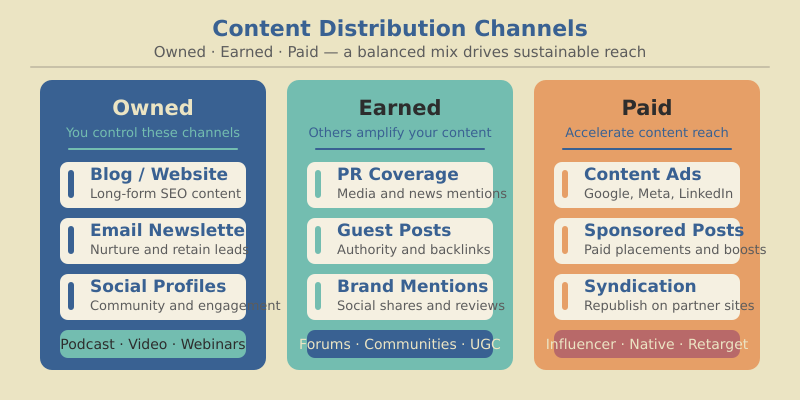
Publishing is table stakes. Distribution is the actual job. The old advice — “create great content and the audience will find you” — was always wishful thinking. It’s catastrophically wrong in today’s environment.
Distribution strategy means deciding, before you hit publish, exactly how you’ll get that content in front of the right people — and then executing relentlessly against that plan.
The Three Distribution Channels
Think in terms of owned, earned, and paid distribution. Most B2B companies over-rely on SEO (owned/earned) and underinvest in the active distribution tactics that compound their results.
| Channel Type | Examples | Best For | Time to Results |
|---|---|---|---|
| Owned | Email list, blog, in-app messages, podcast | Nurturing existing audience | Immediate |
| Earned | SEO, PR, social shares, backlinks, community | Reaching new audiences organically | 3-12 months |
| Paid | LinkedIn Ads, content syndication, sponsored newsletters | Targeting specific accounts or personas fast | Immediate, expensive |
The Email-First Distribution Approach
Your email list is the most valuable content distribution asset you own — because you own it. Algorithm changes, platform shutdowns, and reach collapses don’t affect it. A B2B email list of 5,000 engaged subscribers will consistently outperform a LinkedIn following of 50,000.
Every piece of content you create should fuel your email strategy. Don’t just send a link to the post. Send the insight. Send the takeaway. Give subscribers a reason to actually open the email, not just click through to the full article.
Community-Led Distribution
In B2B, the highest-converting distribution often happens in communities — Slack groups, LinkedIn Groups, Reddit, industry forums, and peer networks. But community distribution only works if you’re genuinely contributing, not just dropping links.
The approach that actually works: identify 3-5 communities where your ICP spends time. Participate authentically for 2-3 months before ever sharing a link. When you do share content, lead with the insight, not the URL. This compounds into a distribution moat competitors can’t replicate.
Apply the 80/20 rule to content marketing: spend 20% of your time creating content and 80% distributing it. Most teams have this exactly backwards — which is why most content dies in obscurity the day after it publishes.
Content Marketing for SaaS: From Awareness to Pipeline
SaaS content marketing has a fundamentally different job than B2C content marketing. You’re not driving a single purchase decision. You’re influencing a long sales cycle, often involving multiple stakeholders, where the content needs to educate, build trust, and accelerate pipeline — not just generate traffic.
If you want to understand the full SaaS growth engine — including how content feeds product-led growth, trial activation, and expansion revenue — I’d point you to my SaaS growth guide. But here I want to focus on the content strategy layer specifically.
Mapping Content to the SaaS Funnel
SaaS funnels have distinct stages, and each one needs different content:
- Problem-aware — the buyer knows they have a challenge but doesn’t know solutions exist. Educational TOFU content: “Why your marketing attribution is broken.”
- Solution-aware — they’re researching categories. Comparison and how-to content: “Best analytics tools for SaaS” or “How to set up conversion tracking.”
- Product-aware — they know your product exists and are evaluating. Case studies, ROI calculators, technical documentation.
- Customer — they’ve signed up. Onboarding guides, product tutorials, help center content that drives activation and retention.
Product-Led Content: The SaaS Content Advantage
Product-led content is content that naturally pulls readers toward your product as the solution — not through hard sells, but by demonstrating the problem you solve in the context of the product itself. It’s the difference between a generic “what is customer churn?” post and a specific “how to reduce churn using behavioral cohort analysis” guide that natively showcases what your analytics platform does.
This approach requires close collaboration between content and product. The content team needs to understand the product deeply enough to embed it authentically into educational content. The payoff is enormous: content that ranks for high-intent keywords AND converts visitors into trial sign-ups because the product is the natural next step.
The best content marketers understand that their job isn’t to get people to read — it’s to get people to change. Change their thinking, change their behavior, and ultimately change their relationship with your brand.
Chief Strategy Advisor, Content Marketing Institute
Content for Customer Retention
SaaS companies often forget that content marketing doesn’t stop at the signup. Post-acquisition content — product tutorials, use case guides, feature announcements, and customer success stories — directly impacts activation rates, feature adoption, and ultimately churn.
When I’ve worked with SaaS companies on content audits, I consistently find that the highest-ROI content investments are often in the post-signup journey: onboarding email sequences, in-app help content, and community-based tutorials. This content is cheap to produce and has a direct, measurable impact on retention metrics.
Your best content asset isn’t your most-trafficked blog post. It’s your customer onboarding sequence. A 10% improvement in 30-day activation rates compounds into significantly lower churn and higher NRR — with no paid media required.
Measuring Content ROI: Metrics That Actually Matter
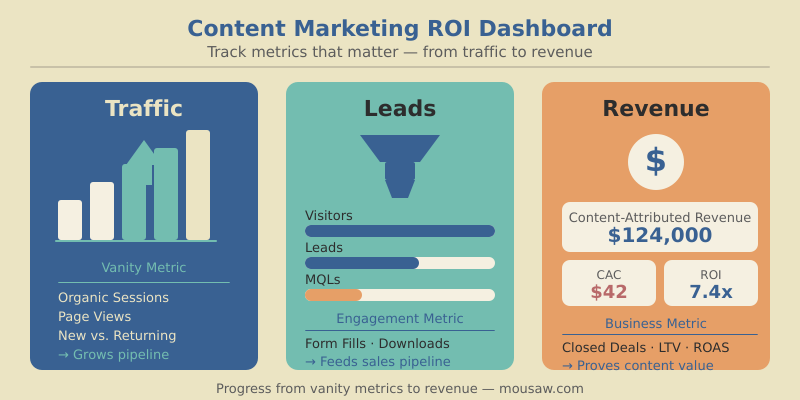
This is where most content programs break down. Teams measure what’s easy to measure — pageviews, social shares, email opens — and report those as success metrics. Leadership then (rightly) asks what any of that has to do with revenue, and the content team can’t answer.
You need a metrics stack that connects content to business outcomes. For a deeper look at building these measurement systems in GA4, check out my GA4 complete guide. Here’s the strategic framework.
The Three Levels of Content Metrics
Level 1: Reach metrics — organic sessions, keyword rankings, email subscribers, social reach. These tell you whether your content is being seen. Necessary but insufficient on their own.
Level 2: Engagement metrics — time on page, scroll depth, newsletter click rate, return visitor rate. These tell you whether your content is resonating. Better, but still upstream of revenue.
Level 3: Revenue impact metrics — content-assisted trials, content-assisted pipeline, content-influenced churn reduction, content-driven expansion. These are what leadership actually cares about — and what most content teams can’t measure.
Setting Up Content Attribution
The attribution problem is real: most content touchpoints happen weeks or months before a conversion, and they’re difficult to tie to a specific deal. But “difficult” doesn’t mean impossible.
Start with first-touch and multi-touch attribution in your CRM. Tag content with UTM parameters consistently. Use GA4’s path exploration to understand what content appears in the pre-conversion journey. And run simple cohort analysis: do leads who engaged with X content type have better trial-to-paid conversion rates?
You don’t need a perfect attribution model. You need directional data that helps you invest in the right content types.
Content ROI Benchmarks
The most important metric to track over time is your content-influenced pipeline: the percentage of closed-won deals where a content touchpoint appeared in the buyer journey. CMI’s research shows that top-performing B2B content teams have 40%+ of pipeline influenced by content. That’s the north star.
Frequently Asked Questions
Conclusion: Build the System, Then Trust It
A content marketing strategy that works isn’t glamorous. It’s a system: a clear topic architecture, a disciplined production process, an active distribution playbook, and a measurement framework that connects content to revenue.
The SaaS and B2B companies that win at content aren’t necessarily the ones with the biggest teams or the largest budgets. They’re the ones who’ve built the system — and then trusted it long enough for the compounding to kick in.
Here’s where to start: run your content audit. Inventory everything you’ve published. Identify what’s ranking, what’s converting, and what’s dead weight. Then build your first topic cluster around your highest-value keyword. Don’t try to execute everything in this guide at once — build the foundation first.
If you’re operating in the SaaS world, read my piece on SaaS growth strategy alongside this guide — the two are deeply interconnected. And when you’re ready to instrument your content’s impact with GA4, the GA4 complete guide will show you exactly how to set up the attribution and funnel reports you need.
The content marketing opportunity in B2B has never been bigger. Most of your competitors are publishing mediocre content and wondering why it isn’t working. Build the system, be patient, and don’t be mediocre. That’s the whole strategy.