What’s in This Guide
- What Makes an SEO Strategy in 2026
- The Six Pillars of Modern SEO
- Technical SEO: The Foundation
- On-Page SEO and Content Optimization
- Building Topical Authority with Content Clusters
- Link Building That Still Works
- SEO for AI: Optimizing for AI Overviews and LLMs
- Measuring SEO Success
- Frequently Asked Questions
I’ve spent the past decade helping companies build organic traffic from zero. And the one thing I can tell you with absolute certainty: the marketers who win at SEO aren’t the ones chasing the latest algorithm update. They’re the ones with a documented SEO strategy that adapts to how search evolves — not just how it worked three years ago.
Search in 2026 looks meaningfully different from 2022. Google AI Overviews now appear at the top of results for hundreds of millions of queries. Large language models like ChatGPT and Perplexity are routing information-seeking traffic away from traditional search. And Google’s own Helpful Content guidance has permanently shifted the bar for what earns rankings.
This playbook covers the entire modern SEO framework — technical foundations, on-page optimization, topical authority, link building, and emerging AI-search optimization — with the specific tactics I use for clients right now. If you want a strong foundation alongside your SEO work, my SaaS growth guide covers how organic pairs with product-led acquisition channels.
Let’s build your strategy.
What Makes an SEO Strategy in 2026
An SEO strategy is a documented, prioritized plan to increase your site’s visibility in search results in ways that drive qualified traffic and business outcomes. The key word there is “documented.” Without a written plan, SEO becomes a scattered collection of tactics — and that’s exactly why most companies see inconsistent results.
The old model of SEO was essentially: find keywords, build pages, get links. That still matters. But it’s no longer sufficient on its own. Modern SEO requires you to think about four overlapping dimensions:
- Discoverability — Can Google crawl and index your content reliably?
- Relevance — Does your content actually answer what searchers need?
- Authority — Does Google trust your site as a credible source on this topic?
- Visibility in AI surfaces — Can AI systems surface your content in overviews and LLM responses?
That fourth dimension is new — and it’s what separates an up-to-date strategy from one that’s already behind. I’ll cover it specifically in the AI section below, but keep it in mind as a thread running through every pillar.
SEO is no longer about ranking pages in isolation. It’s about building a topical ecosystem that signals deep expertise to both Google’s algorithm and AI systems that synthesize search results on users’ behalf.
The Six Pillars of Modern SEO
After working on SEO strategies across SaaS, media, e-commerce, and B2B sites, I’ve distilled what consistently moves the needle into six interconnected areas. Think of these as the structural pillars of your strategy — weaken any one of them and the whole structure underperforms.
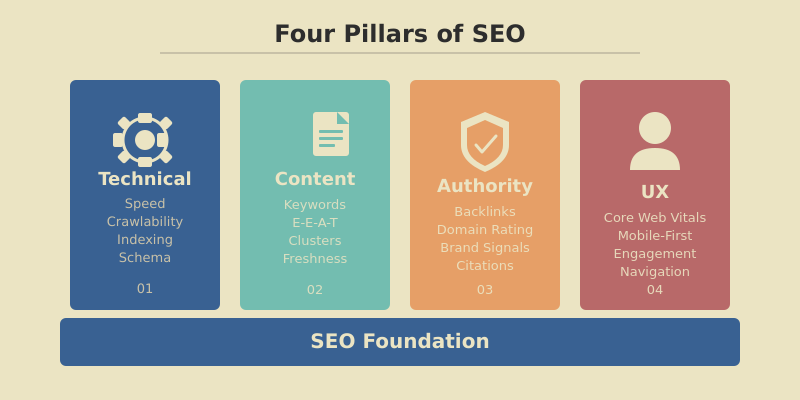
Each pillar feeds the others. Technical SEO makes your content crawlable. On-page optimization makes it relevant. Topical authority makes Google trust your domain. Links amplify that trust. AI optimization extends your reach into new surfaces. And analytics tells you what’s working so you can double down.
Technical SEO: The Foundation
I like to think of technical SEO as the plumbing of your site. Nobody notices good plumbing. But when it fails, nothing else matters. If Google can’t efficiently crawl and index your pages, your content strategy and link building are running uphill.
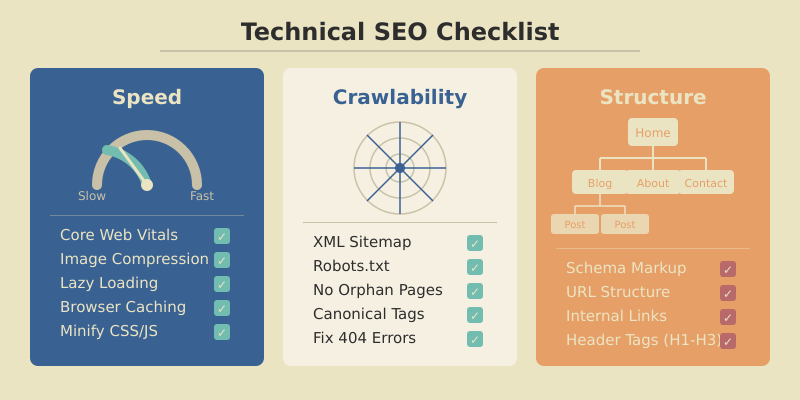
The most impactful technical areas to audit — in priority order:
Core Web Vitals
Core Web Vitals (LCP, INP, and CLS) are Google’s user experience metrics and an official ranking factor. According to Google’s own documentation, pages that pass Core Web Vitals thresholds consistently outperform those that don’t, all else being equal. I’ve seen traffic improvements of 18–25% after optimizing LCP alone on content-heavy sites.
Crawl Budget and Indexation
Googlebot doesn’t have unlimited time to spend on your site. Large sites waste crawl budget on pagination, filtered URLs, thin tag pages, and duplicate content. Use Google Search Console‘s Page Indexing report to find pages that aren’t being indexed and understand why.
Key technical SEO checklist elements:
| Technical Area | What to Check | Priority |
|---|---|---|
| Crawlability | robots.txt, noindex tags, crawl errors in GSC | Critical |
| Site Speed | LCP, INP, CLS scores in PageSpeed Insights | Critical |
| HTTPS | SSL certificate, HTTP→HTTPS redirects, mixed content | Critical |
| XML Sitemap | Submitted to GSC, only includes indexable URLs | High |
| Canonical Tags | Self-referencing canonicals, no cross-domain conflicts | High |
| Internal Linking | No orphan pages, logical site hierarchy, consistent anchors | High |
| Structured Data | Article, FAQ, BreadcrumbList, Organization schema | Medium |
| Mobile Usability | No mobile-specific errors in GSC, tap targets sized correctly | Medium |
| Redirect Chains | No chains longer than 2 hops, no redirect loops | Medium |
| Duplicate Content | URL parameter handling, paginated content, printer pages | Medium |
Technical SEO isn’t a one-time fix — it’s an ongoing maintenance layer. Schedule a quarterly technical audit using a tool like Screaming Frog or Ahrefs Site Audit to catch regressions before they compound.
On-Page SEO and Content Optimization
On-page SEO is the practice of optimizing individual pages to rank for specific queries. It’s where keyword research meets content craft — and where most teams either get it right or leave significant traffic on the table.
The single most important on-page principle I’ve learned: match search intent precisely before you worry about anything else. Intent comes in four flavors — informational, navigational, commercial, and transactional — and Google’s ranking signals are heavily calibrated to reward pages that serve the right intent type.
The On-Page Optimization Framework
For every page you optimize, work through this framework in sequence:
- Intent matching — Study the top 5 ranking pages. What format are they? What do they include? Mirror the intent, then differentiate with depth and unique insight.
- Keyword placement — Primary keyword in the title tag, H1, first 100 words, and at least one H2. Once is enough — Backlinko’s research shows keyword density has minimal effect after the first natural placement.
- Semantic coverage — Use related terms and entities naturally throughout. This tells Google you’ve covered the topic comprehensively, not just targeted a single phrase.
- Title tag and meta description — The title drives click-through rate. Keep it under 60 characters, lead with the keyword, and include a compelling benefit or differentiator.
- E-E-A-T signals — Add author bios, cite sources, include original data or case examples, and demonstrate first-hand experience.
“The best SEO is done by people who genuinely love the topic and genuinely want to serve their audience. Google’s systems, over time, consistently reward authentic expertise over manufactured signals.”
Co-founder, SparkToro; Founder, Moz
E-E-A-T: Google’s Quality Framework
E-E-A-T stands for Experience, Expertise, Authoritativeness, and Trustworthiness. Google’s Quality Rater Guidelines use it to evaluate content quality — and its influence on rankings has grown substantially since the Helpful Content Update rollouts of 2023 and 2024.
Concrete ways to build E-E-A-T into your content:
- Include specific numbers from real work (“We increased organic sessions by 43% in 90 days”)
- Link to primary sources — Google documentation, peer-reviewed studies, industry reports
- Show who wrote the content and why they’re qualified
- Acknowledge limitations honestly (“This approach works best for sites with 50+ pages”)
- Update content regularly and note the last-updated date
Building Topical Authority with Content Clusters
This is where modern SEO diverges most sharply from the old “one great page per keyword” model. Topical authority is the concept that Google ranks sites more confidently when they cover an entire subject area in depth — not just individual queries in isolation.
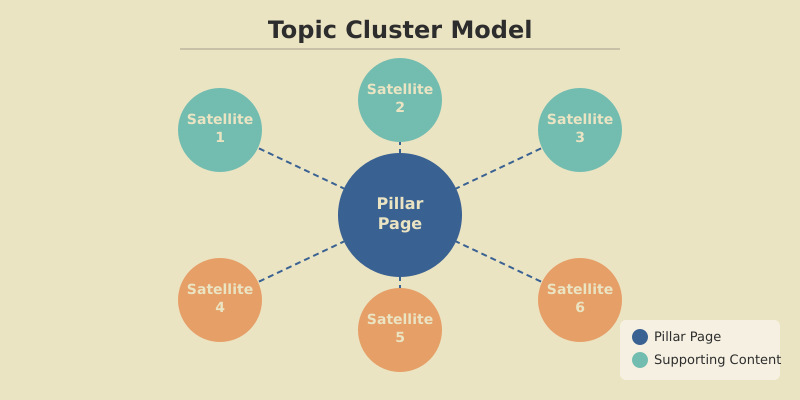
The mechanism that builds topical authority is the content cluster: a pillar page covering the broad topic comprehensively, surrounded by satellite articles covering specific subtopics in depth, all internally linked to each other.
How to Structure a Content Cluster
When I build content clusters for clients, I follow a four-step process:
- Define the pillar topic — A broad, high-volume keyword that represents your core expertise area. This becomes a comprehensive guide (usually 3,000–6,000 words) that covers the full topic at a high level.
- Map the subtopics — Use Google’s “People Also Ask,” keyword research tools, and forum research to identify every question your audience asks about the topic. Each subtopic becomes a satellite article.
- Build the internal linking structure — Every satellite links back to the pillar. The pillar links out to each satellite. Satellites also cross-link where relevant. This creates a web of topical signals that reinforce each other.
- Fill coverage gaps — Use Moz’s topic modeling research as a guide: sites that cover a topic from more angles outrank those with thinner coverage, even when individual pages are comparable in quality.
On a B2B SaaS content project, publishing 6 cluster articles around a single pillar topic lifted the pillar page from position 18 to position 4 within 11 weeks — without any new backlinks. Internal linking and topical coverage did all the work.
This same model applies to your broader content marketing strategy. If you’re building content clusters across multiple topics, you’ll want to read my upcoming content marketing strategy guide — it covers how to plan, prioritize, and execute a content program at the cluster level. For SaaS companies specifically, product-led SEO takes this further by aligning every content cluster with self-serve signup paths.
Link Building That Still Works
Backlinks remain one of Google’s most important ranking signals. Despite years of speculation about their declining importance, the data consistently shows that authoritative, relevant links from external sites correlate strongly with top rankings. Ahrefs’ analysis of 1 billion pages found that 95% of pages get zero organic traffic — and the pages that do rank almost universally have backlinks.
But the nature of effective link building has changed. Manipulative tactics — private blog networks, paid links disguised as editorial, spammy guest post mills — carry real algorithmic and manual penalty risk. The strategies that consistently work are harder but more durable.
Link Building Strategies by Impact
| Strategy | Effort | Link Quality | Scalability |
|---|---|---|---|
| Original data / research reports | High | Very High | Low–Medium |
| Digital PR (newsjacking, expert commentary) | Medium | High | Medium |
| Broken link building | Medium | Medium–High | Medium |
| Resource page link building | Medium | Medium | Medium |
| Strategic guest posting (editorial, selective) | Medium | Medium | Medium |
| HARO / Qwoted expert responses | Low–Medium | Medium–High | High |
| Unlinked brand mentions | Low | Medium | High |
“The links that move rankings are the ones you genuinely earn by being the best answer. If you’re building links by tricking people, you’re playing a game Google is actively trying to end.”
Search Advocate, Google
My most reliably effective link building tactic: original data. A single well-promoted survey, industry benchmark report, or proprietary dataset can earn dozens of editorial links from journalists, bloggers, and researchers — all citing your brand as the source. It takes real investment, but the compounding value is exceptional.
Stop thinking about link building as a volume game. One editorial link from a respected industry publication or major news outlet moves the needle more than 50 generic guest post links. Invest in being genuinely linkable — through original research, expert positioning, and remarkable content.
SEO for AI: Optimizing for AI Overviews and LLMs
This is the section that most SEO guides written before 2024 don’t include — and it’s increasingly where the competitive edge lives. Generative Engine Optimization (GEO) is the emerging discipline of optimizing content to appear in AI-generated responses: Google AI Overviews, ChatGPT, Perplexity, Bing Copilot, and similar systems.
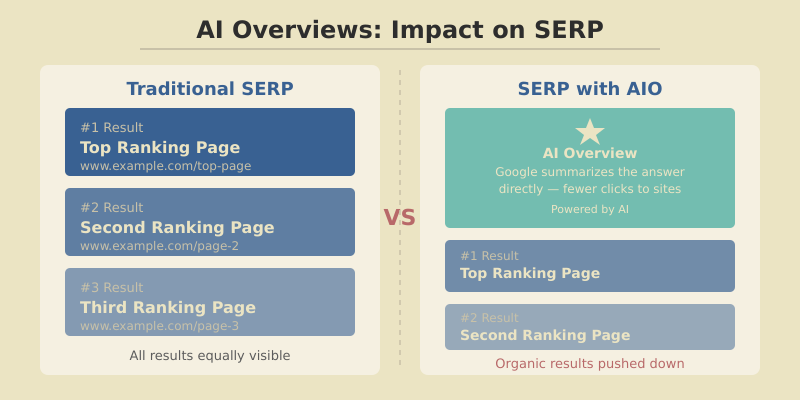
According to Search Engine Land, Google AI Overviews now appear for roughly 15% of all queries — with significantly higher prevalence for health, finance, and how-to topics. Early studies show that AI Overviews reduce click-through rates for the queries where they appear, which means if you’re not cited in the overview, you may lose traffic you previously owned.
What Gets Featured in AI Overviews
Ahrefs’ research on AI Overviews found several consistent patterns in the content Google chooses to synthesize:
- High-authority domains — Sites with strong backlink profiles and established domain authority are cited more frequently
- Direct, structured answers — Content that answers questions clearly in the first few sentences, without burying the answer
- Comprehensive coverage — Pages that address the full context of a query, not just the surface-level answer
- Structured data — FAQ, How-To, and Article schema help AI systems parse and cite your content accurately
- Brand mentions across the web — The more your brand is cited on external sites, the more AI systems treat you as a credible source
How to Optimize for LLMs
LLMs like ChatGPT and Perplexity pull from their training data and live web retrieval. To appear in their responses:
- Get cited in authoritative publications (Wikipedia mentions help significantly)
- Write with clear definitions and structured formatting — headers, lists, and tables are AI-readable
- Include statistics with source citations — LLMs are more likely to surface attributed data
- Use your brand name consistently across all content so systems associate expertise with your entity
- Maintain a
llms.txtfile (an emerging standard) to signal to LLMs which content is authoritative
“The sites that will win in AI-mediated search are the ones that have already built real topical authority. AI systems are basically trust machines — they synthesize from sources they’ve already determined are credible. You can’t shortcut credibility.”
VP of SEO Strategy & Research, Amsive
GEO is still an emerging discipline, and the best practices are evolving fast. For a complete breakdown of how each AI platform cites content differently — and what to do about it — read our dedicated GEO vs. SEO guide. You can also track AI referral traffic in your GA4 setup to measure your GEO performance.
Measuring SEO Success
You can’t manage what you don’t measure. A solid SEO strategy without a measurement framework is just organized guesswork. Here’s what I track — and when each metric matters.
The SEO Measurement Stack
The core tools you need:
- Google Search Console — Impressions, clicks, average position, CTR, Core Web Vitals, index coverage. This is your primary source of truth for organic search performance. It’s free and direct from Google.
- Google Analytics 4 — Organic sessions, engagement rate, conversions by landing page, and revenue attribution. GA4 lets you connect SEO performance to business outcomes, not just traffic numbers.
- Rank tracking tool (Ahrefs, Semrush, or Moz) — Weekly keyword position tracking for your target terms. Correlate ranking changes with content updates, link acquisition, and algorithm updates.
- Backlink monitor — Track new and lost links. Sudden losses in referring domains can signal a penalty or algorithm demotion worth investigating.
For a deeper look at building measurement systems in GA4 — including custom reports for SEO landing page performance and organic conversion attribution — my complete GA4 guide walks through the exact setup I use.
Those four tools are only half of the measurement stack. The other half is one page where they meet, so you stop pasting Search Console clicks next to GA4 conversions by hand every Monday. Here is how I build a Looker Studio dashboard for SEO reporting that pulls both automatically and updates itself. The one page where Search Console and GA4 actually share a row is a blend, and because the join is where those reports go wrong, I wrote up the GA4 and Search Console blend in Looker Studio separately, join key included.
KPIs Worth Reporting
Different stakeholders care about different metrics. Here’s how I frame SEO reporting depending on the audience:
- Executive/board: Organic revenue or pipeline influenced, organic traffic trend YoY, estimated traffic value
- Marketing team: Organic sessions, keyword rankings for target terms, CTR from GSC, backlinks earned
- Content team: Pages getting impressions but low CTR (optimization opportunity), pages losing rankings (refresh needed), new pages indexed and ranking
- Technical team: Core Web Vitals scores, crawl errors, index coverage, page experience signals
One mistake I see constantly: teams obsessing over average position while ignoring click-through rate. A page ranked #3 with a 15% CTR beats a page ranked #1 with a 3% CTR every single time. Optimize your title tags and meta descriptions like ad copy — they’re your first impression in search results.
Frequently Asked Questions
Build Your SEO Strategy One Pillar at a Time
A strong SEO strategy isn’t built overnight. But it also doesn’t have to be complicated. The companies and sites I’ve seen achieve consistent organic growth all share the same approach: they documented a clear strategy, committed to building topical authority in their niche, invested in technical fundamentals, and measured what mattered.
Here’s where I’d start if I were building from scratch today:
- Fix the technical foundation first. Crawl your site, address any indexation issues, and get your Core Web Vitals into the green. Everything else compounds faster on a solid base.
- Choose one content cluster to own. Pick the topic area most relevant to your business and build the pillar + 5–6 satellites before expanding. Depth beats breadth in topical authority.
- Write for humans, structure for machines. Answer questions directly and completely. Use headers, lists, and tables so both Google and AI systems can parse your content cleanly.
- Earn links through genuine value. One piece of original research or a definitive guide in your niche will do more for your link profile than any outreach campaign.
- Track the right metrics. Connect SEO performance to business outcomes in GA4 so you can defend the investment and know what to scale.
SEO done well is one of the most durable growth channels available — especially for SaaS and B2B businesses where the sales cycle is long and paid channels get expensive fast. If you’re building alongside a product-led growth motion, the intersection of organic content and product-led acquisition is especially powerful — something I cover in depth in my SaaS growth playbook.
Start with your strategy. Build your first cluster. Measure and iterate. That’s the playbook — and it works.